A listing that says a San Diego house was re-stuccoed is describing a past coat of stucco, not a couple of patches. Homeowners hear the same word when a plasterer says the old finish is finished. Either way, the useful question is what actually went on the wall, and what was left underneath.
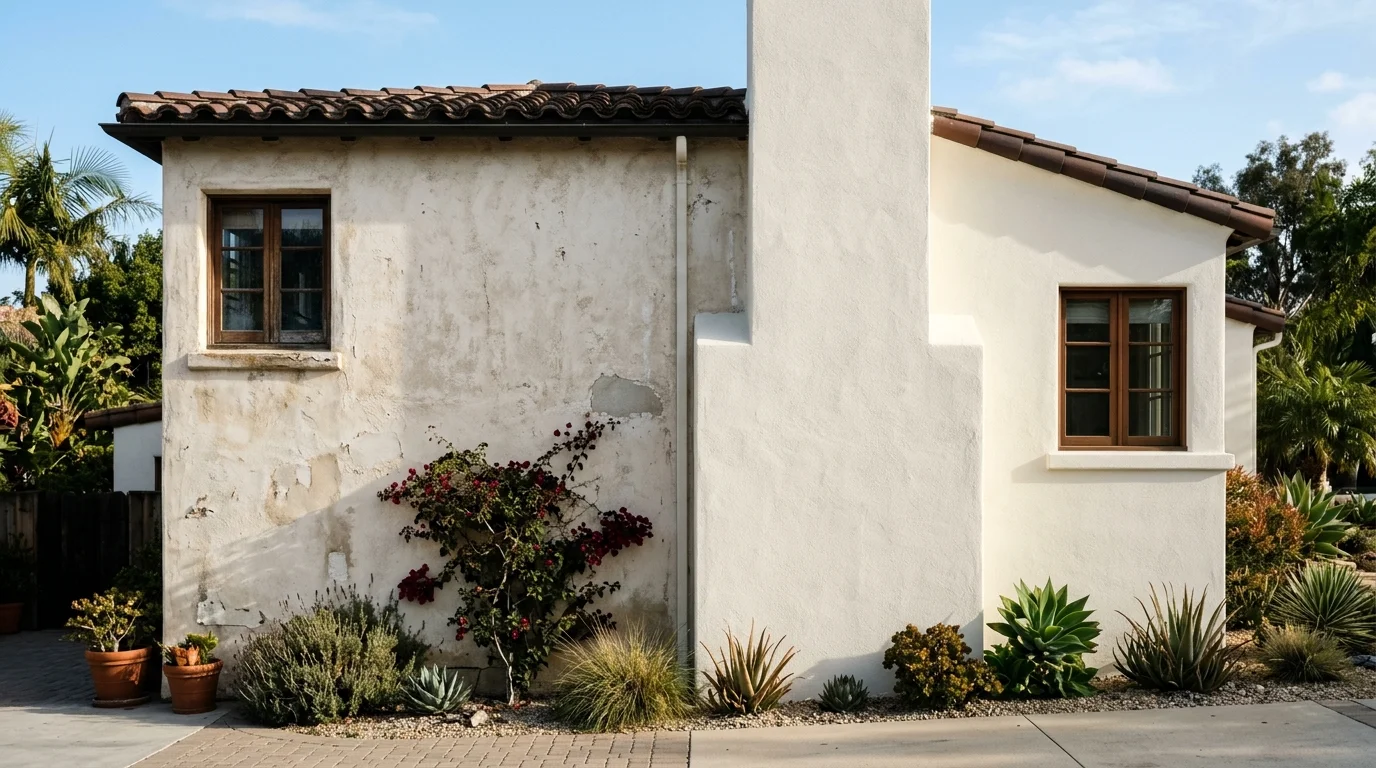
What re-stuccoed means in contractor language
Re-stuccoed is past tense. It means a new stucco finish already went on a large field of wall, often a whole elevation or the whole house. It does not mean a crack got filled. It does not mean the garage corner in National City got a dab of mix. When people ask what restuccoed means, that is the core of it: a new coat, already done, over a lot of wall.
The forward version of the same job is to re-stucco a house. Same work, different tense. Listings in Clairemont, Mira Mesa, and Chula Vista love the past-tense line. So do notes from a walk-through in El Cajon or Oceanside when someone says the finish is too far gone for a small repair. Both uses point at a large finish job. Neither use is a spec.
Contractor language is looser than buyers hope. Some crews call a color coat a re-stucco. Some mean they added a new finish over sound old stucco. Some mean they took failed material down and started over. Those are different scopes. A written contract is the only place the difference holds still. If a seller or a neighbor uses the word with no paperwork, treat it as a label.
The word also does not tell you how many coats went on. Coat counts, cure times, and thickness numbers are not confirmed in our claims file. They come from the matched pro and the product the crew is using. Do not pull those figures from a blog.
San Diego housing stock makes the label slipperier still. A 1960s ranch in Allied Gardens, a 1980s tract in Rancho Peñasquitos, and a bungalow in Ocean Beach can all be called re-stuccoed. The walls under that finish are not the same. Coastal salt air in Encinitas ages a coat one way. Inland heat in El Cajon ages it another. The South Bay marine layer around Imperial Beach and San Ysidro keeps walls damp longer than a dry lot in Alpine. A C-35 plasterer reads the wall in front of them. They do not take listing language at face value.
Stucco is a C-35 trade in California, lathing and plastering. If you have a name from an old invoice, check it on the CSLB license lookup. Stucco Pro SD matches homeowners with licensed independent local pros. This brand does not hold the trade license and does not do the physical work.
How a re-stucco differs from a patch or a color coat
A patch is local. A hose-bib hole, a window swap in La Mesa, or a cracked garage corner gets filled and textured to blend. That is stucco patching. The rest of the wall stays as it is. If you can still see the old color field around the repair, the house was not re-stuccoed.
A color coat is a thin new color layer over stucco that is still bonded. It can hide fade and light texture wear. It does not rebuild a failed wall. The decision between those two paths already lives on our patch vs recoat page. This page is not that math. It owns the past-tense search term and the scope.
Re-stucco sits above both. The crew is covering a whole elevation, or the whole house, with a new stucco finish. They do that after they decide the existing surface can take it, or after they remove what cannot. That is why “re-stuccoed” on a Point Loma listing and “we patched the south wall” in Spring Valley are not interchangeable.
Watch the overlap from the street. A color coat on four sides can look like a re-stucco from the curb. A large patch that wraps a corner return can look like a re-stucco from the driveway. The test is what the written scope said: area, product, whether old stucco stayed, and what failed areas got opened. If nobody wrote that down, you are guessing.
San Diego light makes the guess worse. Morning sun on a west wall in Pacific Beach shows a color miss a north wall in Kensington never will. East County dust and heat bleach a finish faster than a shaded lot in La Jolla. A house can look freshly re-stuccoed from the sidewalk and still have an old, painted, or patched system under the new color. Look at the walls in raking light, not only at noon.
Do not use price to tell the jobs apart. This brand does not publish job costs, starting-at figures, or averages. How bids get built is on the cost to restucco in San Diego page. Restucco vs patch in San Diego is a scope question first. Patch is a spot. Color coat is a skin. Re-stucco is a new stucco finish on a large field.
What has to be sound before a new coat goes on
A new coat only belongs on a wall that can hold it. Hollow spots, cracks that keep moving, rusted lath, wet sheathing, and paint peeling in sheets are not a sound base. The matched pro has to find those before anyone mixes finish.
On a coastal house in Imperial Beach or Encinitas, moisture at window heads, deck ledgers, and the grade line is the usual tell. Inland in Escondido or Alpine, long dry spells and hot days show up as map cracking and old patches that keep opening. South Bay homes near the bay pick up salt and lingering damp. None of that is a diagnosis of your parcel. It is why a San Diego look at the wall is local, not generic.
In plain words, the pro is checking:
- Bond. Does the old stucco still stick, or does it sound hollow when tapped.
- Movement. Are cracks hairline and stable, or stepping and widening.
- Moisture. Stains, soft spots, or a musty smell at penetrations.
- Metal. Lath or trim rusting through the finish.
- Coatings. Failing paint that would sit between old stucco and a new coat.
Weep screed height, coat thickness, and cure time are not confirmed here. Do not take internet numbers for those. The matched plasterer and the product data they follow set them. If a permit is in play, City of San Diego Development Services or the building department for your city sets the rule. Unincorporated Ramona is not the same counter as the City of San Diego. Chula Vista, Oceanside, and El Cajon each run their own.
California regulates exterior walls in wildland-urban interface areas under California Building Code Chapter 7A, with Cal Fire and the State Fire Marshal. Whether a given lot is in a high fire hazard severity zone is a mapped call. Nobody on this page can tell you your address is or is not in one. Check Cal Fire’s maps and ask the local building department. Do not assume a re-stucco changes that picture.
If the old stucco is sound, a re-stucco can mean a new finish over what is already there. If it is not sound, the talk shifts to opening the wall. That is a different job, not a small add-on.
When removal becomes part of the conversation
Removal enters when the existing system cannot take a new coat honestly. Soft or wet stucco, stucco that has let go of the wall, rusted lath, failed paper, and walls overcoated into a stack of skins are the usual reasons. Painting over a problem is not a re-stucco. Adding finish on a wall that is already letting water in is not one either.
A buyer who hears “recently re-stuccoed” on a house in University City should still ask what came off. If the answer is nothing, they just coated it, the old defects are still in the wall. If they opened the bad bays and rebuilt those, you have a mixed wall: new work in some fields, old work in others. Mixed walls are common on San Diego additions, where a 1970s garage meets a later family room in Tierrasanta or La Mesa.
This brand does not pull material and does not pull permits. A licensed independent pro decides, on site, whether the finish can stay. Permit need is a building-department question. California’s contractor exemption for small work sits at $1,000 for labor, materials, and all other items, effective January 1, 2026. Both conditions must hold: under $1,000, and no permit required. Splitting a job to stay under that number is not allowed. Anyone who advertises as a contractor loses the exemption at any price. A whole-house re-stucco is almost never that kind of small job. The matched pro and the local department still set the call.
If removal is on the table, get it in writing as its own line. What comes off, how far, where debris goes, and what the wall is rebuilt to before a new finish starts. Home improvement down payments in California cannot exceed $1,000 or 10 percent of the contract, whichever is less. On a large job that cap is $1,000, not 10 percent of a big number.
What belongs in a written re-stucco scope
A useful scope answers the search term with facts about this house, not a slogan. It should say the house will be re-stuccoed, or was re-stuccoed, in language a later buyer can read.
Put these items on paper:
- Elevations. North, south, east, west, or named walls. “The house” is too vague on a split-level in Tierrasanta or a canyon lot in La Mesa.
- What stays. Existing stucco left in place, or opened to a stated layer.
- What comes off. Failed areas, trim, old coatings, or nothing.
- Finish. The product the pro is actually using, plus texture and color. “Match existing” needs a sample on the wall, not a memory of a neighbor in Carlsbad.
- Penetrations. Windows, doors, scuppers, hose bibs, light boxes, and the grade line.
- Access. Scaffold, hillside, an alley in South Park, HOA rules in a gated East County tract.
- Exclusions. Paint, roof, foam trim, and anything the plasterer is not touching.
- License. The C-35 contractor’s CSLB number, verified on the official lookup, not a third-party site.
- Permit. Who asks the building department. The department, not this referral brand, makes the ruling.
Unlicensed contracting in California is a misdemeanor under Business and Professions Code section 7028 unless an exemption applies. Do not invent jail time or fine amounts. Those were not confirmed here. The pros we connect you with are licensed and insured. This brand matches you with those independent pros and performs no physical work.
If you already had the work done, keep the invoice, the color code, and photos of the wall before the new coat. That packet is what re-stuccoed should have meant all along. If you are deciding whether to re-stucco a house, walk the elevations with the matched pro first. Encinitas salt, El Cajon heat, and a shaded lot in North Park will not take the same prep.
When to call us
Call when a listing, an inspector, or a contractor has used the word re-stuccoed and you need a licensed plasterer to say what that should mean on your walls. Call us at (858) 400-4352 and we’ll connect you with a licensed local stucco contractor.