The listing called it siding. The paint store sold you siding caulk. A lot of San Diego County walls that look like that are EIFS, a foam-backed finish people still search as EIFS siding repair. The damage on the face is real. What it means depends on the assembly behind it, and that assembly is not lap siding.
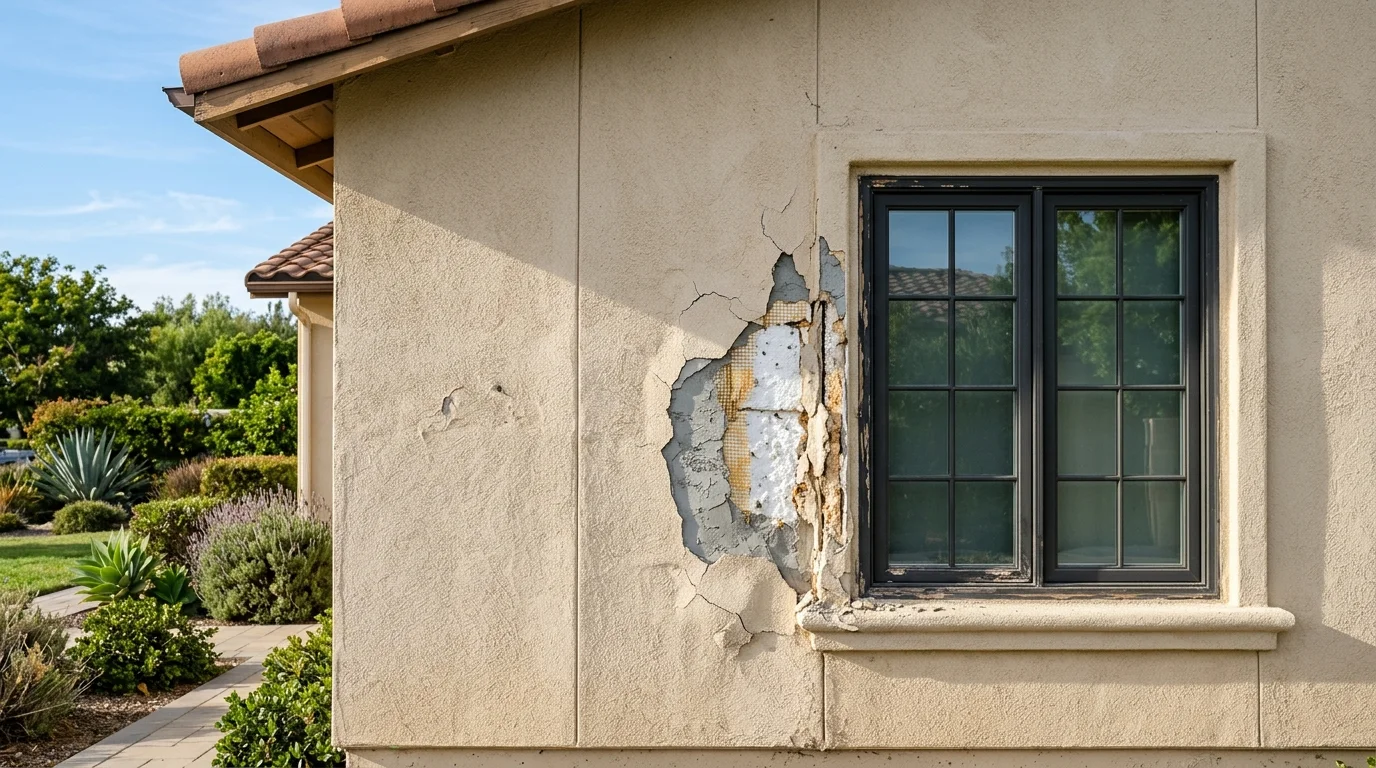
Why some walls called siding are actually EIFS
Real wood or fiber-cement siding is a board. You can pull one piece, flash the gap, and hang a new one. EIFS is a layered wall finish: foam board, mesh, base coat, and a thin textured skin. From the curb in Clairemont, Rancho Bernardo, or a 1990s Chula Vista tract, it can look like a stucco panel or a thick painted siding. Knock on it. It sounds hollow compared with three-coat stucco, which is still the common exterior on older coastal bungalows and a lot of East County block.
People use “synthetic stucco siding repair” because that is the language a home inspector or a neighbor used. The system is still EIFS. If you want the plain definition of the layers, read what EIFS (synthetic stucco) actually is. The repair path follows those layers, not a siding board.
San Diego County is not one climate for this cladding. Coastal north county, Encinitas through Carlsbad, sits in salt air and a long marine layer. Joints stay damp longer. Inland north county, Escondido and San Marcos, swings hotter and drier in the afternoon. East County, El Cajon, Santee, Alpine, cooks the finish and moves the foam with heat. South Bay, National City and Imperial Beach, mixes marine moisture with tight lots, hose bibs, and patio covers punched through the wall. A page that treats Encinitas and El Cajon as the same wall is guessing.
You will also see mixed houses. A 1960s three-coat body with an EIFS addition over the garage. Foam trim glued onto cement stucco. A foam-shape entry that everyone calls “the siding around the door.” EIFS repair on those jobs starts by naming the system, not by matching a paint chip.
The brand you are reading matches you with a licensed independent pro. That pro does the physical work. Stucco in California is a C-35 trade (lathing and plastering). Confirm the license on the CSLB license check before anyone opens the wall. Under California Business and Professions Code 7048, unlicensed work is only in a narrow lane: the whole job under $1,000 (that threshold is effective January 1, 2026), the work is casual or minor, and no permit is required. Both the price cap and the no-permit rule have to hold. Splitting a job to stay under $1,000 does not create an exemption. Anyone advertising as a contractor loses it at any price. Acting as a contractor without a license is a misdemeanor under B&P 7028.
What surface damage can and cannot show
A hairline in the finish coat is not a diagnosis. On EIFS it can stop in the acrylic skin, cut the mesh, or sit over crushed foam. You cannot tell which one from a phone photo, and a licensed pro should not pretend to. EIFS wall siding damage on the face is a clue. It is not a moisture map.
What you can see from the yard: cracked or peeled finish, dents from a basketball or a trimmer, open joints at foam bands, staining under a window stool, patches that read as a different texture. Coastal houses from Pacific Beach to Imperial Beach often show salt bloom and failed sealant before they show a wide crack. Inland houses along the I-8 corridor more often show UV chalking and corner cracks where the foam moved.
What the surface cannot prove: whether water is in the sheathing, whether the foam is wet, whether a stain is dirt or a leak path. Do not treat a dark patch as hidden rot. Do not treat a clean face as a dry wall. Those calls need looking at the assembly, and sometimes openings the homeowner authorizes. A moisture conversation on this cladding belongs with waterproofing and a moisture barrier, not with a tube of siding caulk.
Soft spots, a hollow that feels crushed, or finish that moves when you press near a window are reasons to stop patching from a ladder. They are still not a photo diagnosis. The pro you get matched with can compare suspect areas, look at how the wall was terminated, and say whether a small opening is justified. If the house sits in a mapped wildland-urban interface, California Building Code Chapter 7A can affect exterior-wall work. Whether your parcel is in a fire hazard severity zone is a mapped call. Check Cal Fire’s maps and your city or county building department. Do not take a blog’s word for your lot.
Insurance questions come up on this search. A blanket “carriers hate EIFS” rule for San Diego County could not be confirmed here. Ask your own insurer what they underwrite, and keep the repair file as photos, a written scope, and the contractor’s CSLB number. Do not treat a forum story as a policy.
Can EIFS be repaired? Yes. Licensed pros repair it when the system is identified and the failed details are in the scope. A skim that hides a joint leak is not that repair.
Where joints, windows, and impacts usually fail
Most EIFS siding repair in this county is not a random field crack. It clusters where water and hits already concentrate.
Windows and doors first. The finish dies into a sealant joint at the frame. That joint weathers hard on west-facing walls in Point Loma and on south walls in El Cajon. When the bead splits, water does not need a hole in the field. It uses the opening that was always there. Deck ledgers, roof kickouts, and the top of foam bands fail the same way. If the original installer wrapped those transitions poorly, a pretty finish still leaks at the cut.
Impacts are the other cluster. Trash cans, kids’ bikes, ladder feet, irrigation heads, and fence posts. Foam crushes. The mesh tears. The finish looks like a chip. On real siding you swap a board. On EIFS the crushed foam is the wall. A surface fill over a dent leaves a soft spot that opens again. Coastal wind-driven rain then uses that dent as a pocket.
Lower walls take hose spray and planter soil. South Bay and central-city lots often have grade, irrigation, and stucco or EIFS in the same two feet of wall. That is a water-management problem, not a texture problem. Penetrations (lights, outlets, phone boxes) are small, and they fail like windows: the sealant is the detail.
Joints between foam shapes, between an EIFS bay and three-coat stucco, and at control joints are where people caulk for years. Caulk is not a cladding. If the joint was the drainage or the movement joint, packing it only moves the crack. A repair eifs siding scope that ignores those lines will look fine for a season and then reprint the same map.
When the licensed pro is on site, those locations should be photographed, not summarized as “misc. cracks.” Window heads, sills, corners, deck attachments, and the bottom termination each get a note. That is how you tell a siding-style patch from a wall-system repair.
When a small patch is not the right repair
A small patch is the right call when the finish is scuffed, the foam is still sound, the mesh is intact, and the joint next to it still sheds water. That is a limited synthetic stucco siding repair. It is not the default.
Skip the bag-and-trowel shortcut when any of this is true. The crack keeps returning on the same line. Stain comes back after rain. The wall feels soft. You can see mesh or foam. A prior patch already failed. The damage sits at a window, a deck, a roof-wall, or a hose bib. The “siding” is an addition butted into old three-coat, and the joint is open. In those cases the job is to open enough of the system to fix the detail, then rebuild the layers so the patch is part of the wall again.
That is also where people search “how do you patch EIFS” and get a video of topping compound. Field technique for a sound, small area is a different article. Use how to repair EIFS for that sequence. This page is the decision before anyone mixes product: patch the skin, or repair the assembly.
Cost per square foot is a common follow-up. No verified per-square-foot figure for this brand, and none belongs on this page. Quotes move with access, story height, finish match, how much foam comes off, and whether openings are needed. A coastal La Jolla wall with failed window joints is not an East County dent from a trimmer. Ask for a written number from the licensed pro. Confirm it before you pay.
If the work needs a permit, the local building department sets that, not a blog. In the City of San Diego, start with Development Services. Unincorporated county and other cities have their own counters. Do not assume a patch is exempt. Do not assume a full bay replacement is automatically permitted. Ask the department that maps your address.
Warranties, if any, come from the matched contractor and the material maker, not from this referral service. Do not treat a lifespan marketing line as a standard. Those figures are not verified here.
What a written EIFS repair scope should include
A useful scope reads like a wall, not like a siding invoice. It names EIFS (or the brand system if the pro can identify it), not “stucco patch.” It lists each elevation and each opening. It says what will be opened, what will be replaced (finish only, mesh and base, foam, or the failed joint), and what will be left in place. It says how the new finish will be textured and coated so the bay does not flash in July sun on a Santee west wall.
It should also say how water is handled at the repair. Sealant type at windows and penetrations. Whether a weather-resistive detail is part of the work. Who owns flashings if a window is reset. If moisture is in the conversation, the scope should say whether testing or openings are proposed, and that those openings need your say-so first. Guessing from the driveway is not a line item.
License and money terms belong on paper. The contractor’s CSLB number, checked on the official lookup. For a home improvement contract, California B&P 7159.5 caps the downpayment at $1,000 or 10 percent of the contract, whichever is less. On a large job that cap is $1,000, not 10 percent of the total. Unlicensed contracting remains a misdemeanor. This site matches you with licensed independent pros. It does not pull the permit, hold the C-35, or warrant the work.
A complete scope also flags neighbors of the repair: paint or finish on the rest of the elevation, foam trim that will be cut, and any mix of EIFS and cement stucco. Texture matching on this system is its own skill. If the bid is silent on match, you will see the patch from the street.
Ask for photos of the failed details in the bid, not stock images. Ask what happens if they open a window joint and find a wet edge. A change-order path in writing is clearer than a verbal “we’ll see.” If Chapter 7A or a fire-hazard map might apply, the pro and the building department resolve that for the parcel. This page will not declare your zone.
When that packet is in your hands, you are buying EIFS siding repair as a wall job. That is the search, and that is the work.
When to call us
Call when the cladding you were told is siding is cracking at windows, crushing from impact, or staining after rain, and you need a licensed stucco contractor to name the system and write a real repair. Call us at (858) 400-4352 and we’ll connect you with a licensed local stucco contractor.