A Clairemont ranch or a Chula Vista two-story with tired stucco often sparks the same remodel idea: leave the plaster in place and face it with brick. That is the reverse of the usual masonry job, and it is a different decision. The existing wall has to be identified, checked, and signed off before anyone covers it.
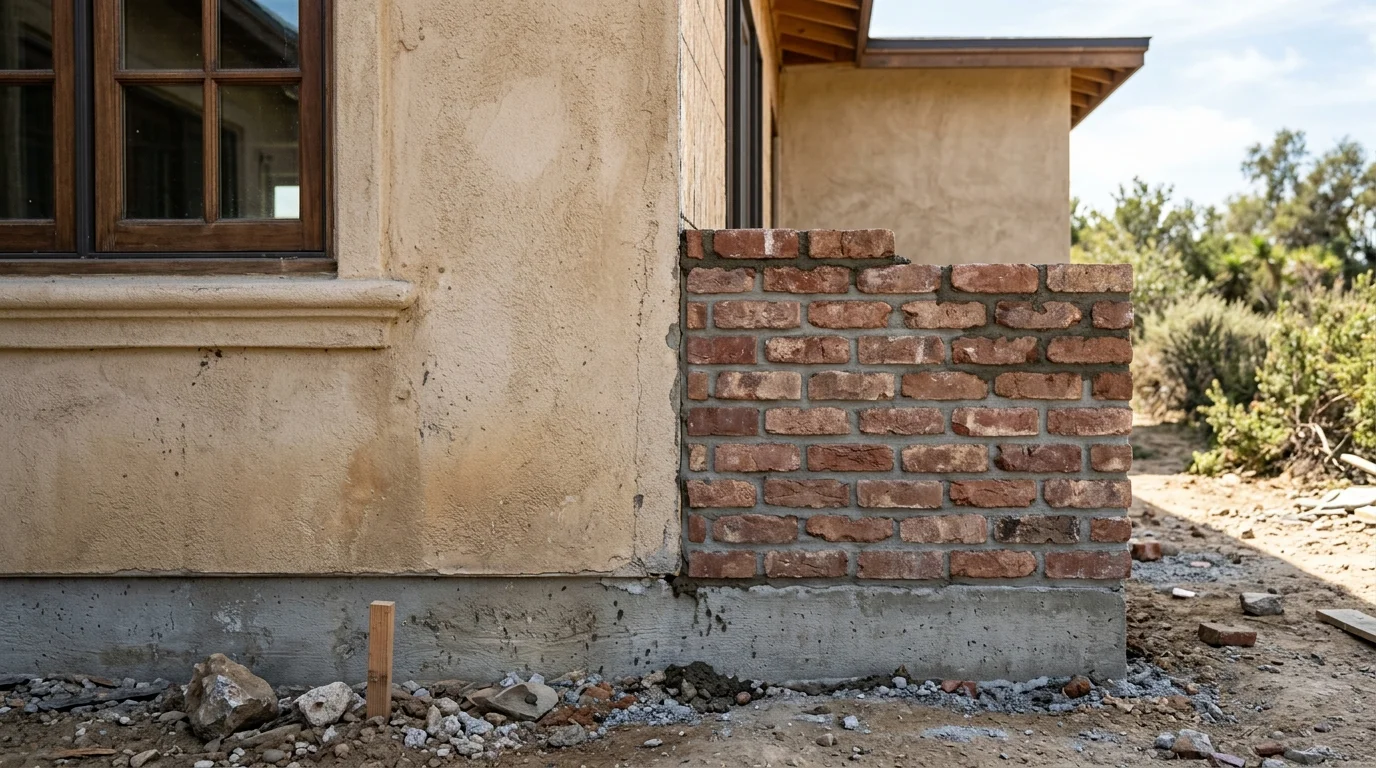
You can put brick over stucco only when the existing wall is sound, dry, and accepted as part of a named system. A licensed independent pro and the local building department confirm that assembly. If the coat is loose, wet, or unknown, covering it is the wrong move. Stucco removal is often the safer path on San Diego County homes.
Why the existing wall assembly matters first
San Diego County is not one stucco wall. Coastal houses from Ocean Beach through Encinitas take salt air and the marine layer. Inland tracts in Escondido, Santee, and El Cajon bake, then take Santa Ana winds. South Bay homes in National City and San Ysidro often sit closer to grade and see different rain splash. East County sun hits the same finish harder. The plaster you see from the sidewalk is only the outer coat.
What sits under that coat changes the brick question. Traditional cement stucco over lath is one assembly. Painted or coated stucco is another. A foam-based synthetic system is a third. A parged masonry wall is a fourth. Brick, thin brick, and manufactured stone each add thickness and weight in different ways. None of those systems can be assumed from curb appeal.
The published guide on stucco over brick and block covers the other direction: plaster going onto masonry. Putting brick over plaster is not the same stack. The old stucco was never designed as a brick backup. Treating it as a ready bonding surface is the mistake that shows up later as hollow spots, staining at the sills, and water that has nowhere honest to leave.
A licensed contractor has to name the existing assembly. Color, texture, and decade of the tract are clues, not a diagnosis. Many 1960s through 1990s San Diego houses got a cement coat, then years of paint. Some additions picked up a different system than the original walls. Mixing those without saying so in the scope is how one elevation fails while another looks fine for a season.
Permit rules sit with the city or county that has the house. In the City of San Diego, start with Development Services. Chula Vista, Oceanside, Escondido, El Cajon, and the unincorporated county run their own counters. California also regulates exterior wall assemblies in wildland-urban interface areas through Building Code Chapter 7A. Whether a given parcel sits in a high fire hazard severity zone is a mapped determination. Check Cal Fire’s maps and the local building department. Do not assume the zone from the neighborhood name.
Full-thickness brick and a thin adhered veneer are different jobs. One is not a swap for the other. This page does not assign weight limits, fastener schedules, or a footing rule to either one. Those calls belong to the licensed installer, the product listing, and the building department that will see the house.
What must be checked before covering old stucco
Before anyone talks brick veneer over stucco, the wall itself gets a real inspection. A walk-by from the driveway is not that inspection.
Start with cracks and movement. Hairline crazing is common on older San Diego coats. Wide cracks, stair-step cracks, corner cracks at windows, and cracks that keep opening are a stop. Bulges, crumbling patches, and areas that move under hand pressure are a stop. Covering a loose coat hides the failure and loads it.
Tap and listen. Hollow sounds can mean the plaster has let go of the lath or the sheathing. Solid sound is not a lab test, but a wall that rings empty in sheets should not be a substrate for a new face. Map those areas on the elevation, not just the pretty front.
Moisture is the other gate. Dark stains under windows, white powder on the surface, soft spots, peeling paint, and damp interior drywall at the same height all point to water already in the wall. Coastal fog and winter storms drive that pattern on west-facing walls from Point Loma to Carlsbad. Inland, splash from planters and poor grade does the same work. Adding a new face without fixing the path does not dry the wall. Waterproofing and a moisture barrier belong in the conversation before a veneer is ordered.
Paint and coatings matter. Many county homes have been rolled or sprayed more than once. Elastomeric coats show up on sun-hit east county walls and on houses that were chasing leaks. A coating can keep a new mortar bed from grabbing. The matched pro has to say how that coating is handled. Do not treat a painted wall as a clean cement face.
Unknown foam or synthetic systems need extra caution. If the wall feels unusually light, shows mesh at a chip, or was built when those systems were common on additions, stop and identify it. Guessing the substrate from the texture is not a method.
The contractor should also confirm there is framing or masonry behind the plaster that can take whatever fastening the chosen system requires. Specific lath types, mortar mixes, scratch-coat recipes, and weight caps are not verified here. Those come from the product’s listed instructions, the licensed installer, and the building department. Other claddings get sold as “something you can put over stucco.” Each one is its own system. This page answers brick over stucco. Stone over stucco raises the same inspection bar. It is not a lighter version of the same yes.
When removal may be safer than building over it
Keeping the stucco is only a live option when it is sound, dry, and accepted by the veneer system the contractor names. If those checks fail, stucco removal is the cleaner path.
Removal is the safer call when large areas sound hollow or pull away. It is the safer call when water has already stained or softened the wall. It is the safer call when the finish is a coating or foam system the brick maker will not accept. It is the safer call when windows, sills, and the base cannot take the extra thickness. It is the safer call when the building department wants the substrate exposed.
Taking the coat off lets the pro see sheathing, wrap or paper, and lath. That is how hidden rot and rusted metal get found instead of boxed in for another rainy season. Our guide on when stucco has to come off walks through those failure patterns in plain language.
Homeowners ask whether removal is worth it. If the plaster is failing, yes, because a new brick face will not repair the old wall. If the coat is sound, the licensed pro still has to confirm that leaving it in place is allowed for that product and that house. Worth is not a slogan. It is the cost of doing the wall once versus doing it twice after a covered leak shows up inside a Vista or La Mesa living room.
There is no verified county-wide price for changing stucco to brick. Quotes move with tear-off, disposal, openings, access, height, and whether the old coat stays. A blog number would be a guess. Ask for a written scope from a licensed independent pro. Compare that scope, not a round figure from a search result.
Covering bad stucco to skip demolition is how moisture stays in the wall through another winter. San Diego’s dry summers hide that choice until the first long storm. Then the new brick still looks fine from the street while the sheathing does not.
How windows, doors, and drainage details affect the plan
Brick or brick veneer adds thickness. On a San Diego elevation that thickness shows up first at the openings, not in the middle of a blank wall.
Window and door returns have to be deep enough for the new face, the flashing, and a finished edge. Head flashing, sill pans, and side details have to be planned before the first unit is set. Many 1970s and 1980s tract windows in Mira Mesa, Rancho Peñasquitos, and Spring Valley sit close to the existing stucco plane. Extra depth can force new trim, new flashing, or window work. That is not a cosmetic extra. It is where leaks start.
The base of the wall is the other hard spot. Stucco walls drain at the bottom when they are detailed that way. A new veneer that buries the exit path, bridges the grade, or lands in a planter against a Chula Vista slab can trap water. Exact weep heights, grade clearances, and coat thicknesses are set by code and by the product listing. Those figures are not confirmed in this article. The contractor and the local building department set them for the job.
Roof-to-wall joints, chimney shoulders, and patio covers need the same look. A missed kickout on an El Cajon gable or a Coronado porch beam is a water path with a new cladding in front of it. East County sun and coastal salt both punish a skipped detail. Drainage and moisture-barrier work have to be drawn, not assumed, and they have to stay continuous around every penetration.
Interior brick over an interior plaster wall is a different conversation. Weather, grade, and weep paths are not in play the same way. The substrate still has to be sound, and the installer still has to follow the system that is named. Do not copy an exterior plan onto a fireplace wall, or the reverse.
Stone over stucco raises the same opening and drainage questions. Smaller pieces do not cancel flashing. If the plan cannot show how water leaves the wall at the windows and at the base, the plan is not ready, whether the face is brick or stone.
Which questions belong in the contractor’s written scope
The written scope is where this job stays honest. Verbal confidence is not an assembly.
Ask the contractor to put in writing what the existing wall is: cement stucco, coated stucco, a synthetic system, or masonry. Ask whether the old coat stays, is repaired in place, or comes off. Ask how water is managed at the base, windows, doors, and roof ties. Ask who pulls the permit if one is required. Ask which product system is being used, and that the installer will follow that system’s instructions. Ask how painted or sealed areas are prepared. Ask what happens if removal reveals damaged sheathing or rusted lath.
Ask for the license number, then check it on the CSLB license lookup. Use that official page, not a third-party badge.
Stucco work in California sits under the contractor laws that apply to licensed trades. Unlicensed contracting is a misdemeanor unless an exemption applies. The small-job exemption is only for work under $1,000 in the aggregate, that is casual or minor, and that does not need a permit, effective January 1, 2026. Splitting a job to stay under that number does not create an exemption. Anyone who advertises as a contractor loses the exemption at any price. A brick-over-stucco elevation is not a casual patch. Use a licensed independent pro.
On a home improvement contract, the down payment cannot exceed $1,000 or 10 percent of the contract amount, whichever is less. On a large face-brick job that cap is $1,000, not 10 percent of the total.
Do not accept a scope that says mortar goes straight to the old stucco with no inspection record. Do not accept a scope that skips openings. Do not accept a verbal claim that the wall can hold the new face. Weight, fastening, waterproofing method, and fire-assembly questions belong to the licensed contractor and the building department. This brand matches you with that pro. It does not design the wall or perform the work.
If the honest answer is removal plus a new assembly, that sentence belongs in the contract. A covered-up coat is not a shortcut. It is a second exterior waiting on the first one to fail.
When to call us
Call when you want brick or brick veneer on an existing stucco house in San Diego County and you need a licensed local pro to inspect the wall, talk through keep-or-remove, and write a real scope. Call us at (858) 400-4352 and we’ll connect you with a licensed local stucco contractor.