DIY stucco repair makes sense when the defect is small, dry, accessible, and limited to the surface. The line shifts quickly when you find exposed lath, recurring damage, possible moisture, or a wall you can’t reach from the ground.
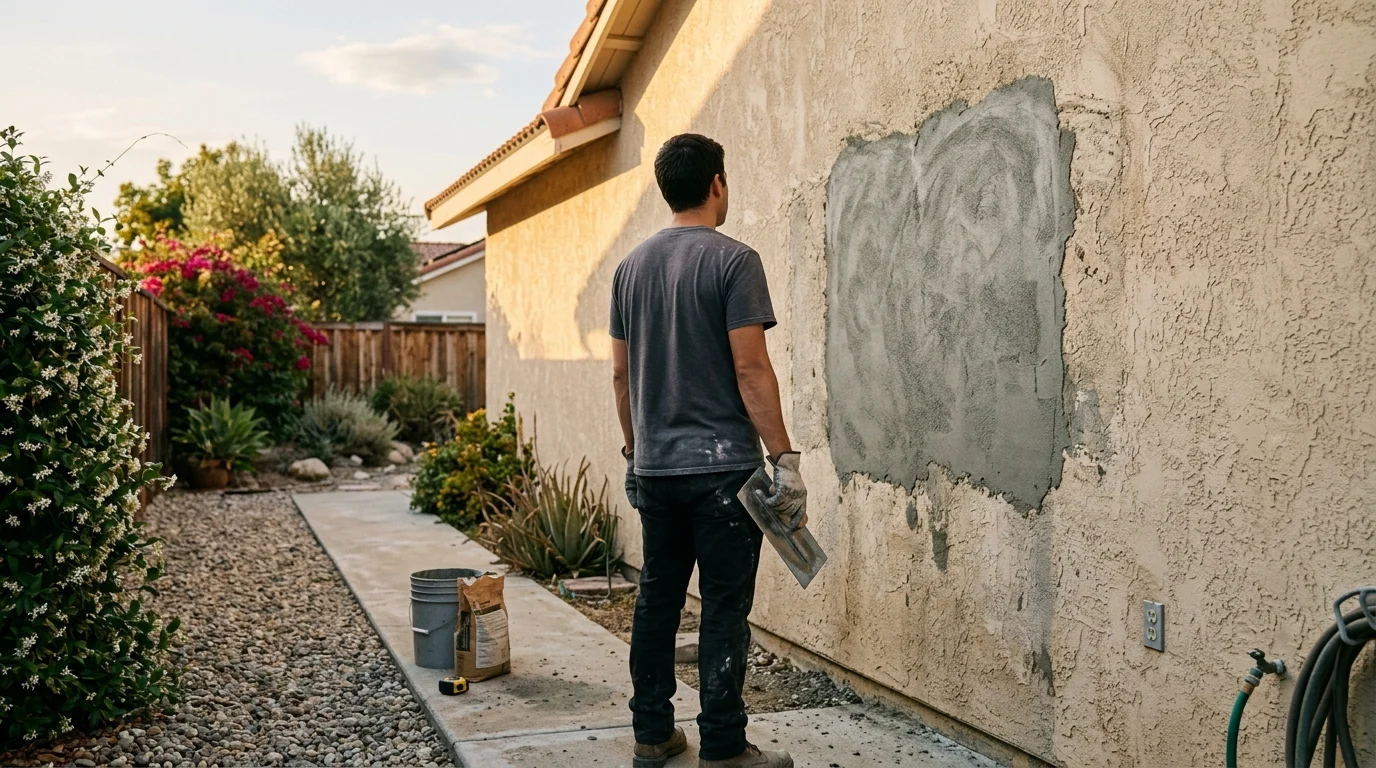
The honest DIY window: what a homeowner can reasonably do well
The best DIY candidate is a minor cosmetic defect with clear boundaries. You can see the whole affected area, reach it from the ground, and find no loose material beyond the visible spot. The surrounding wall should feel firm when examined gently.
Start by deciding whether the job is truly surface-level. Don’t begin by choosing a patching product. First, look at the edges, nearby openings, and the wall below the damage. If the affected area continues behind the finish, a cosmetic patch isn’t the same as a complete repair.
A homeowner can reasonably clean a small surface defect, follow a repair product’s directions, and practice the finish on a sample board. Product labels control mixing, application, protective equipment, and drying instructions. Don’t substitute an online rule of thumb for the manufacturer’s current directions.
San Diego County adds another reason to inspect before mixing. A coastal North County wall and an East County wall don’t share the same exposure or repair history. Judge the wall in front of you, not a video filmed elsewhere.
For a closer look at limited repairs, see our guide to stucco patching.
Hairline cracks and small surface defects
A narrow, surface-level crack is the strongest candidate for DIY work. That doesn’t mean every narrow crack is cosmetic. Its location, pattern, surrounding condition, and repair history still matter.
Clean the area gently so you can see the actual opening. Check whether the edges are firm or crumbling. Look for staining, softness, exposed material, or another crack continuing beyond the spot. If the crack has been repaired before and returned, pause before covering it again.
Choose only a product whose manufacturer identifies your wall type and defect as an intended use. Follow the stated preparation and application directions. The approved crack size, working conditions, and drying period come from that product’s label. A general article can’t replace those instructions.
Keep the first attempt small. Practice the application and texture away from the wall when possible. Once the repair is on the house, extra material can make the patch more visible instead of less.
Our stucco crack repair page explains when a crack deserves professional attention. If you can’t tell how deep it runs, treat that uncertainty as part of the decision.
What changes the moment lath or water is involved
Visible lath ends the simple DIY conversation. The defect now extends below the outer surface, so filling the opening alone doesn’t address the full exposed area. Stop removing material and let a licensed stucco contractor inspect the assembly.
Possible water involvement also changes the scope. Warning signs can include staining, dampness, softness, recurring discoloration, or damage near a window, door, roof connection, or wall penetration. Those signs don’t identify the source by themselves. They do show why covering the surface may be premature.
Don’t guess where water began or how far it traveled. The source and affected layers need to be identified before the finish is closed. A larger patch can hide the area you wanted a contractor to examine.
This distinction matters across San Diego County. Homes in Chula Vista, City Heights, Encinitas, and El Cajon can have different wall histories and exposure. A photo can’t confirm what sits behind a particular finish.
If you uncover metal, membrane, an open cavity, or material you can’t identify, protect the area from disturbance and call a pro. Ask the contractor to explain what was exposed, what needs replacement, and which part is only the visible finish.
The three questions that end the DIY conversation
Three questions separate a cosmetic task from a job needing professional judgment:
- Does the damage continue below the visible surface?
- Is moisture, lath, or an opening in the wall assembly involved?
- Can every part of the repair be reached while staying on the ground?
An uncertain answer counts. DIY instructions can’t inspect hidden layers, determine a water path, or evaluate access conditions at your property.
Also consider the shape of the damage. One isolated surface mark is different from repeated cracking across a wall. Damage clustered around a window, door, vent, or utility penetration deserves closer inspection. So does a patch that failed and reopened.
Take clear photos before touching the area. Include one close view and another showing the entire wall. Add nearby corners, openings, rooflines, and the wall base. Those images help a contractor understand the location, though they don’t replace an in-person inspection.
The decision isn’t about whether you can spread patching material. It’s about whether the visible defect represents the whole problem. When you can’t establish that boundary, stop before opening the wall further.
Texture matching: the skill that takes the longest to learn
Texture often decides whether a repair looks finished or looks patched. The material can fill the defect while the repaired area still catches your eye from across the yard.
Study the wall from several distances and angles. Don’t rely only on a close photo. Texture can vary across the same elevation, especially around older repairs and additions. Choose the intact area immediately beside the defect as your visual reference.
Make a sample before working on the wall. Use a scrap board or another disposable surface. Try the same tool, hand movement, and material consistency you plan to use. Let the sample reach the stage specified by its manufacturer before judging it.
Don’t keep adding material while chasing a perfect match. Each extra pass changes the surface. If the sample remains noticeably different, a texture-matching contractor is the better next step.
Color introduces another judgment call. A texture match and a color match are separate outcomes. Don’t assume leftover material, a familiar color name, or a phone photo will reproduce the existing wall. Ask the material supplier or contractor how the proposed finish will be compared on your specific wall.
Tools you would need to buy versus what a pro already owns
A surface repair may call for cleaning tools, mixing containers, masking materials, an application tool, and a sample board. The selected product may also specify protective equipment. Read that requirement before buying or opening anything.
The tool list changes with the wall and finish. A smooth patch, heavy texture, and narrow crack don’t use identical techniques. If you need several unfamiliar tools just to imitate the existing surface, include that learning curve in your DIY decision.
A licensed stucco contractor should arrive prepared for the repair they agreed to perform. Ask which tools and materials the job requires, especially when the damage may extend below the finish. The answer should fit what you can see on the wall.
Don’t buy materials until you understand the repair boundary. A product intended for a small surface defect doesn’t become suitable for exposed lath because you apply more of it. Keep receipts and unopened packaging until you’ve confirmed the intended use.
For product-specific limits, the current manufacturer instructions are the authority. If the label doesn’t clearly cover your defect or substrate, contact the manufacturer or bring the details to a qualified supplier.
Working at height, and why that alone changes the answer
A repair above ground level isn’t just the same patch placed higher. Access becomes part of the work, and a general article can’t confirm that a ladder, scaffold, platform, or setup is suitable for your property.
Don’t improvise an access method from online photos. Follow the equipment manufacturer’s instructions and any site-specific direction from the professional providing it. If the defect can’t be reached entirely from the ground, getting a licensed contractor’s assessment is the practical line.
This matters on San Diego homes with sloped lots, side-yard walls, chimney surfaces, second-story elevations, and limited access between buildings. The patch may look small from below while the working area is difficult to examine.
Use a zoomed photo for an initial conversation, but don’t treat it as a diagnosis. Tell the contractor where the damage sits and what access exists around the wall. Let that contractor determine the work method.
There isn’t a verified universal height or ladder rule for every stucco repair described here. The equipment manufacturer and the professional evaluating the property set the relevant access requirements.
What California law says about doing the work yourself
California Business and Professions Code section 7048 has a narrow contractor-license exemption. Effective January 1, 2026, the aggregate contract price for labor, materials, and all other items must be less than $1,000. The work must also be casual and minor, and it can’t require a building permit.
Every condition matters. A job below $1,000 doesn’t qualify if a permit is required. Splitting a larger project into smaller contracts to avoid licensing is expressly excluded. Anyone advertising as a contractor also loses this exemption at any price.
The older $500 figure still appears online, but it isn’t the current threshold. Don’t use it when evaluating work in 2026.
This law doesn’t establish that your particular repair is permit-free. Permit requirements depend on the property and scope. No single rule for every DIY stucco repair could be confirmed here. Ask the city or county that issues permits where you live before work starts.
Unlicensed contracting outside an exemption is a misdemeanor under Business and Professions Code section 7028. For stucco work, the CSLB trade classification is C-35, Lathing and Plastering.
If you decide to hire, our guide to hiring a stucco contractor in San Diego walks through the selection process.
Deposit rules and how a homeowner protects themselves
California’s home improvement downpayment rule is specific. Under Business and Professions Code section 7159.5, the downpayment can’t exceed $1,000 or 10 percent of the contract amount, whichever is less.
“Whichever is less” controls the calculation. The rule isn’t a flat permission to collect 10 percent on every contract. It also doesn’t establish the total price of a stucco repair.
Before paying, compare the contractor’s legal name with the written agreement and license record. Keep a copy of the signed agreement, payment records, product descriptions, and any written changes. Make sure the repair area and intended finish are described clearly enough for both sides to identify them.
This article can’t confirm a later-payment schedule for your specific project. Review that schedule before signing and ask the CSLB about any term you don’t understand. Any warranty offered must come from the independent contractor, not Stucco Pro SD, and its terms should be reviewed in writing.
Don’t let urgency replace verification. A small patch can wait long enough for you to confirm who is contracting for the work and what the agreement requires.
How to check a license before anyone starts
Use the official CSLB license check, not a screenshot or third-party directory. Search the license information supplied by the contractor and read the current record yourself.
Confirm that the name on the result matches the person or business entering the agreement. For stucco work, check the displayed classification for C-35, Lathing and Plastering. Read the license status shown on the day you check. If a name, number, classification, or status doesn’t match, stop and ask for an explanation before work begins.
Save the lookup result with your project records. Then compare it again if the contracting party changes. A salesperson’s name, company name, and license record shouldn’t be treated as interchangeable without confirmation.
Stucco Pro SD is a referral service. We connect homeowners with licensed, independent local pros and don’t perform physical work. The contractor you hire is responsible for the scope, permit questions, agreement, and any warranty terms.
When to call us
Call when the repair involves lath, possible moisture, recurring damage, uncertain depth, difficult access, or a texture you can’t reproduce. A licensed local stucco contractor can inspect the specific wall and define the repair scope.
Call us at (858) 400-4352 and we’ll connect you with a licensed local stucco contractor.