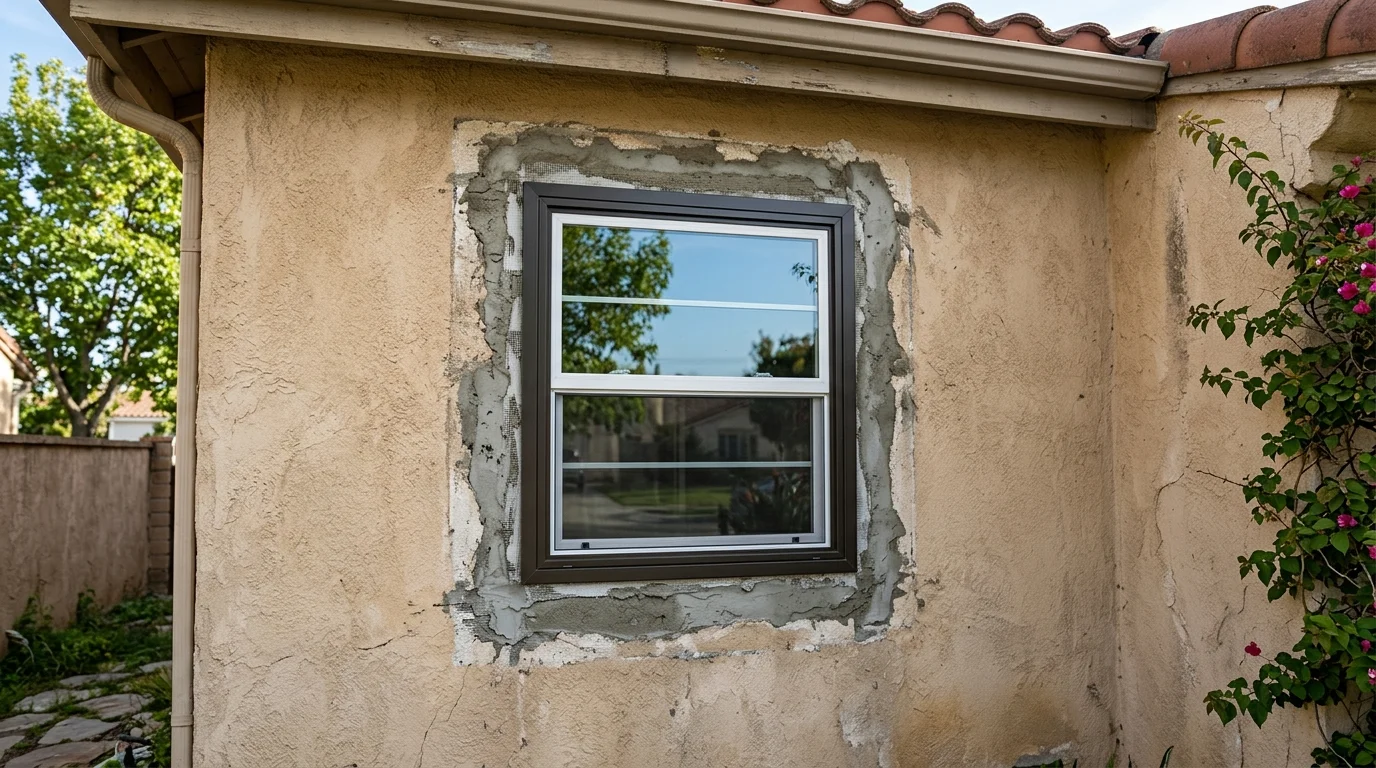
The window crew packed up, and the glass looks right. The wall around the frame still looks like a cut. That unfinished ring is the real stucco repair after window replacement: restoring the finish so the house reads as one wall again.
Why window work leaves a difficult repair boundary
A replacement window sits in an opening that already had a stucco return. Taking the old unit out, or setting a full-frame unit in, cuts that return. You get a hard, often square edge against stucco that’s already aged. The old wall holds sun, salt, and dirt in the texture. The new mix doesn’t.
That’s why a stucco patch around a replacement window is harder than a crack in the field. You’re joining a fresh cut to a weathered surface. On a 1920s bungalow in North Park or Kensington, the old sand float or lace has already rounded. In a 1970s tract in Mira Mesa, the dash finish is coarser and throws more shadow. A two-inch ring of new material won’t disappear on either house.
Coastal north county makes the halo worse. Encinitas, Carlsbad, and Oceanside sit in marine layer and salt air, so the old stucco is lighter on the high spots and darker in the pockets. El Cajon, Santee, and Alpine take harder sun, so fade shows every new square inch.
The new window is also a different plane. Nail fins, stucco stops, and backer change how light hits the joint. Neither the small retrofit scar nor the larger full-frame cut is automatically damage from the window installer. Cutting stucco is part of getting a unit out. Finish restoration is a separate trade.
Stucco is CSLB C-35 lathing and plastering. Window installation isn’t. Look the plastering contractor up on the CSLB license check before anyone starts the patch. Acting as a contractor without a license is a misdemeanor under Business and Professions Code section 7028, unless an exemption applies.
If stains, soft sheathing, or a musty smell showed when the old unit came out, that’s moisture, not texture. Start with stucco around windows, leaks, and repair. This page stays on the finish once the opening is sound.
How the old texture should be identified before patching
Don’t bid a match until someone names the existing finish. San Diego County isn’t one texture. Spanish Colonial houses in Mission Hills, Point Loma, and Coronado often carry a finer sand float or a soft lace. Postwar tracts in Clairemont, Linda Vista, and Chula Vista lean dash, heavy lace, or skip trowel. If the pro can’t name what’s on the wall, the stucco texture window patch will be a guess.
Look at the wall in raking light, not noon sun on the south face. Walk to a corner where the texture is original, not painted thick, not previously patched. Fine sand reads tight. Coarse dash throws deep shadows. Lace has a pulled, irregular ridge. Photograph that sample next to the window cut, on the same elevation, at the same time of day.
A west wall in Cardiff takes salt and wet air. A west wall in Escondido bakes without the marine layer. An east wall on the same house may be closer to the original. El Cajon south elevations bleach faster than north ones. Matching the wrong elevation is how a perfect sample still looks wrong around the new frame.
Texture matching is its own scope, not a leftover from the window bid. The pro should make a small sample or a test patch away from the frame before committing the whole perimeter. Compare that sample to the original wall, not to a catalog photo. How texture matching works across San Diego County covers the county-wide version of this problem. The window perimeter is just the hardest place to hide it.
Paint film can fake a texture, so check a hidden spot behind a downspout before you match the window ring. Don’t assume a color coat will recreate a dash that was built. Texture is built. Color sits on top.
What lath and moisture details need checking first
Finish work doesn’t fix a cut that went into the weather-resistive barrier. Before anyone trowels, the opening needs a look behind the stucco face. That isn’t a leak diagnosis. It’s the minimum check so a pretty patch isn’t sitting on torn paper or short lath.
See whether the metal lath was cut clean, bent back, or left short of the new frame. Lath that doesn’t lap the opening gives the new plaster nothing to key to. The patch then bonds to the window or the old coat, and the joint telegraphs later. If the lath is rusted, pulled off the fasteners, or missing at the corners, stucco patching on top of it is a finish over a failed substrate.
Paper or wrap sliced during the swap should still be visible at the cut. If it’s shredded, missing, or stuffed with leftover foam, the finish coat won’t make the wall weathertight. The window’s flashing and sealant aren’t a substitute for a continuous barrier behind stucco. When that layer is open, the licensed pro should stop and say so.
Confirm the current detail with the contractor. If a permit is involved, ask the building department that actually has jurisdiction. The specific city office name for that permit desk could not be confirmed here, so check with the city or county that has the parcel. The license threshold in B&P section 7048 is $1,000, effective January 1, 2026. Both conditions must hold: under $1,000, and no permit required. Splitting the job doesn’t create an exemption. On a home improvement contract, the down payment can’t exceed $1,000 or 10 percent of the contract amount, whichever is less.
Moisture staining, swollen wood, or a damp smell is a stop, not a texture problem. Whether a given parcel sits in a mapped fire hazard zone is a mapped call, so check Cal Fire’s maps and your local building department.
When the match should extend to a natural break
A tight ring around the frame is the cheapest-looking drawing. It’s also the one that usually fails the eye. New stucco meets old stucco on a line that nothing else in the wall explains. Your brain reads that line as a patch, even when the mix is close.
Natural breaks give the eye a reason for a change. Inside and outside corners. A control joint. The edge of a recessed window reveal. A change from wall to soffit. A story band or a trim return. Many San Diego Spanish and ranch houses already have a deeper plaster reveal at the window. Extending the new work to that reveal is often cleaner than a three-inch halo. A corner in a small Encinitas courtyard can hide a blend that would shout on a long El Cajon side yard in afternoon sun.
This is the part homeowners don’t want to hear. A narrow patch won’t always disappear. Some perimeters are too tight, too faded, or too heavily painted. In those cases the honest scope is to carry the finish to the next break, or to recoat the whole elevation. That isn’t a bigger job for its own sake. It’s how you avoid a picture-frame of new material around every new window on the street.
Ask to see the proposed cut lines marked on the wall before the saw comes out. If the house has four new windows on the west side in Pacific Beach or Imperial Beach, blending each as a separate postage stamp will read as four postage stamps. One controlled field to a corner or a joint often reads as a wall. The job to match stucco around new windows is a blend, not a disappearing act.
How to judge texture before approving the color
Texture and color are different approvals. Don’t sign off on both at once. If the dash, lace, or float is wrong, no color coat will save it. If the texture is right and the color is early, you’ll stain a shape you already accepted.
Judge texture first, in raking light, on a dry wall. Morning light on an east wall in La Mesa isn’t the same test as late light on a west wall in Point Loma. Stand back at the sidewalk, then move in to arm’s length. Both views have to be acceptable.
A patch that’s too tight looks like a scar. A patch that’s too coarse looks like a new product. A patch whose ridges run a different way looks like a repair even when the color is close. Wet sheen lies. Wait until the work has lost its dark, damp look before you call it. No verified cure time is on file here, so ask the licensed pro what they want you to wait for, then wait for that.
Only after the texture is accepted should color even be discussed. Color on San Diego stucco shifts with sun, salt, and old paint. A premix that matched a chip in the garage will miss the west wall in Clairemont in afternoon light. Approve a sample on the actual elevation. If the rest of the wall is painted, you’re matching paint history, not original integral color. Keep those as two conversations. Refuse to treat caulk as the finish. Sealant is a joint, not a texture match. When both approvals are right, you should see a window, not a construction cut.
When to call us
Call when the window is in and the stucco around it still reads as a cut, or when you want the finish scoped before the opening is closed. The pros we connect you with are licensed independent stucco contractors who do the plaster work. Call us at (858) 400-4352 and we’ll connect you with a licensed local stucco contractor.