The west wall looked even in spring. After a hot inland stretch, Escondido homeowners start seeing new lines at window corners, garage returns, and the faded face of a 1960s or 1970s ranch. That is valley heat on older plaster, plus irrigation at the base, and it is a different problem than coastal damp or mountain movement.
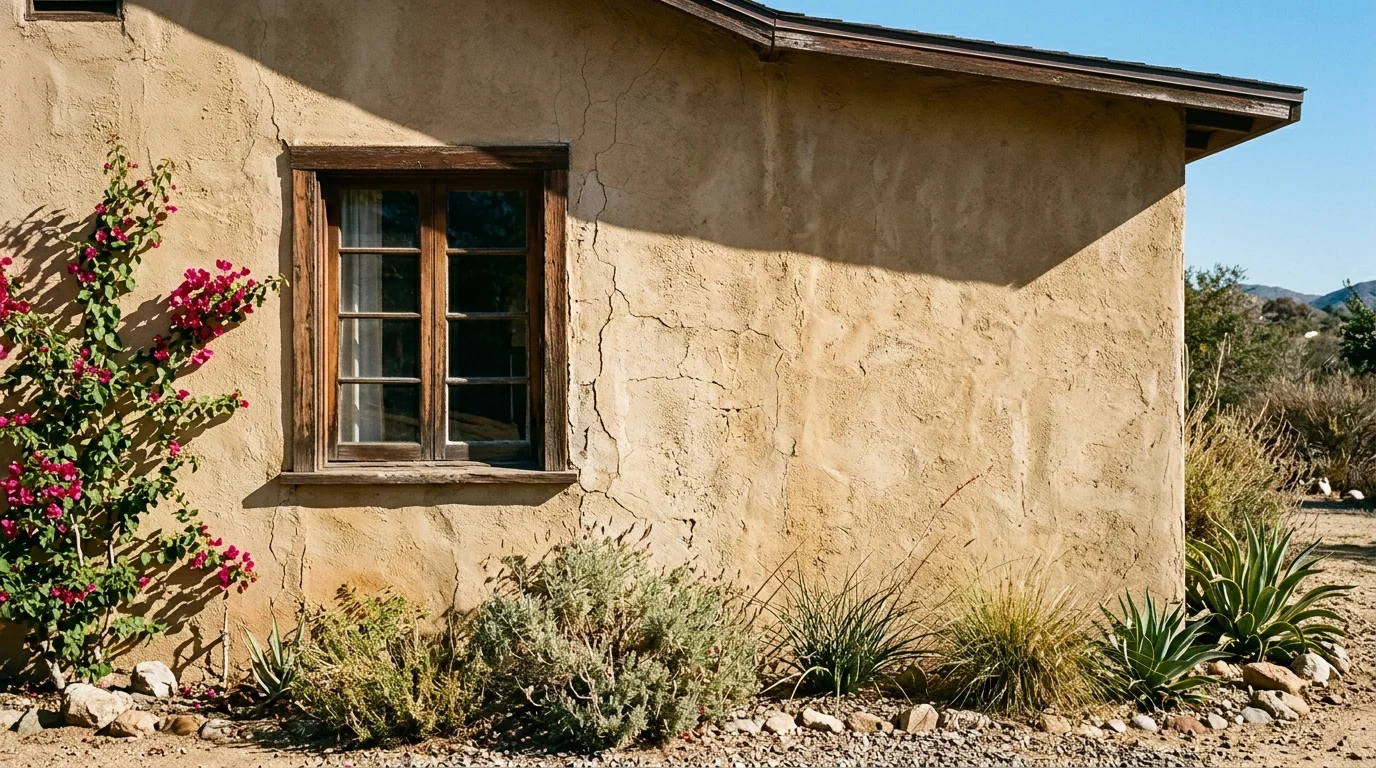
What inland valley heat does to older Escondido stucco
Escondido sits in inland North County, east of San Marcos and well inland of the marine layer that cools Encinitas, Imperial Beach, and Coronado. Afternoon sun sits on west and south walls for hours. Cement stucco expands a little in that heat and shrinks as the wall cools after dark. On a ranch house from the 1960s or a tract house from the 1970s, that cycle has already run for decades.
The finish usually chalks first on those sun sides. A color coat that once read even now looks pale by the hose bib and darker under the eave. Fine cracks show at window heads, at the garage-to-house corner, and where a later patio cover was tied in. That is a brittle skin moving with the day. It is not, by itself, proof the framing is failing.
Do not treat a crack as structural from a photo or from how it looks after one hot week. A licensed C-35 plastering contractor still has to read width, pattern, and whether water is getting behind the finish. Appearance is a clue. It is not a diagnosis.
This is why a generic county page fails here. Imperial Beach fights salt and damp. Coronado fights ocean air on older plaster. Descanso has its own diagonal-crack story in the mountains. Borrego is desert. Escondido’s load is inland valley heat on older housing, with irrigation that never quite matches the wall. If you typed escondido stucco repair after a hot stretch, you are looking at that mix.
Hairline lines that stay hairline after the wall cools are one class of problem. Wider openings, stepped patterns, or cracks that keep growing are another. Our guide to hairline vs structural stucco cracks walks through that difference without asking you to call the house from the curb.
How irrigation and raised planters add to wall stress
Inland yards in Escondido run on irrigation. Raised planters against the stem wall, drip tubing at the base, and spray heads that tick the stucco on a timer all put water where the wall is already taking heat. Soil piled above the bottom of the plaster holds moisture against the base. That is a different stress than coastal fog.
Water at the base and sun on the face pull the finish in two directions. Lines show along the grade, at the corners of planter boxes, and up from the hose bib. Mulch packed against the plaster keeps the base damp after the rest of the wall has baked dry. You will see that most on one-story ranch walls that sit close to the landscaping, which is a lot of the 1960s and 1970s stock near downtown and along the older stretches off Valley Parkway.
A licensed pro looking at stucco repair Escondido work should ask what the sprinklers do at dawn and whether the planter was added after the house was plastered. Moving dirt and redirecting spray is not a substitute for stucco crack repair. Filling a wet crack with caulk is not a wall repair either. If you are tempted to run a bead of silicone along a line, read what actually belongs in a stucco joint first. A tube of sealant does not rebuild the plaster, and it will not match a sun-baked color coat.
What sits under the finish matters when water is in the picture. On typical wood-frame walls, stucco goes over metal lath and a weather-resistive barrier, not as a single decorative skin. Some later remodels used foam-based systems people call fake stucco, which is EIFS. If a wall feels soft or hollow in a way cement plaster does not, say so when you ask for a look. The repair path is not the same.
Do not assume a crack is only cosmetic because the planter looks tidy. Do not assume it is a foundation failure because the soil is wet. Those are guesses. The person who opens the wall, if it needs opening, should be the licensed contractor.
Reading cracks on ranch and tract houses from the 60s through the 80s
A lot of Escondido’s stucco from the 1960s through the 1980s sits on one-story ranch and tract plans: long low walls, a garage at one end, aluminum windows that later got swapped, and patio covers or room additions tied in after the original plaster. Those joints are where heat and old work meet.
Look at pattern before you look at panic. Vertical hairlines at mid-wall, especially on the west side, often track shrinkage in a long run of plaster. Cracks that start at the corner of a window or sliding door and run out at an angle show up where the opening cuts the wall. Lines along a later addition can mean the new work and the old work move differently, which is common when a family room was added in the 1980s onto a 1960s ranch.
Stepped cracks, openings you can catch a fingernail in, or a bulge that was not there last year are reasons to stop guessing and have a licensed pro on site. Still, do not label those structural from the sidewalk. Framing, soil, and plaster each produce lines that can look alike. Our catalog of stucco crack types in San Diego is the map. The house still needs eyes on it.
Window replacement is a local tell. Many inland tract houses had the original aluminum units pulled and new frames set into old plaster. If the crack follows the new trim, the issue may be the patch around the replacement, not the whole elevation. Garage-door corners crack on long ranch facades because that opening is wide and the afternoon sun hits it hard.
Take photos in the same light, same time of day, a week apart. Inland heat makes some lines more visible at 4 p.m. than at 8 a.m. A crack that appears only in raking afternoon light and eases in the morning is still a crack. It is also a clue about thermal movement, not a verdict on the structure.
When a small patch will not blend on a sun-baked wall
Sun-baked Escondido stucco does not hide a small repair the way a north-facing coastal wall can. The west color coat has chalked. The texture has worn. A handful of stucco patching on a two-foot square will often read as a lighter, smoother island after the next hot week.
That does not mean every crack needs a full re-coat. It means the proposal has to say how the finish will be matched, not only how the crack will be filled. On a faded ranch, blending may take a larger color-coat area, or a conversation about recoating a whole elevation so the patch does not telegraph. Those are scope decisions. They are not a promise about price.
Small patches fail for other reasons too. If the base is still wet from irrigation, new material is going onto a wall that has not dried. If the crack is still working with daily heat, a rigid fill can open beside the patch. If the original finish is a dash or lace texture that has weathered for forty years, a smooth trowel spot will show from the street.
Ask the contractor to stand on the west side at the time of day you notice the lines. A sample on the north wall is not the wall you see from the driveway. Paint alone will not hide the work. Paint on a cracked, chalky coat follows the crack.
When a patch is the right call, it should include the crack, the loose finish around it, and a plan for texture and color, not a smear over the line. When it is not, the honest answer is a larger repair or a recoat of that elevation. You want that said before anyone starts.
What to compare in an Escondido repair proposal
A search for the best stucco company Escondido residents can hire is really a search for a licensed independent pro whose scope matches this house. Stucco Pro SD matches you with those pros. We do not plaster the wall, pull the permit, or hold the trade license. The pros we connect you with are licensed and insured.
Compare these items, not slogans.
License first. Stucco work is CSLB C-35, lathing and plastering. Check the number yourself on the CSLB license lookup. Unlicensed contracting is a misdemeanor under California law. Work under $1,000 is exempt only when the total for labor, materials, and everything else stays under that figure, the job is casual and minor, and no building permit is required. That $1,000 threshold is the current rule as of January 1, 2026. Splitting a job into smaller contracts to dodge licensing is not allowed. Anyone who advertises as a contractor loses the exemption at any price.
On a home improvement contract, the down payment cannot exceed $1,000 or 10 percent of the contract amount, whichever is less. On a larger job the cap is $1,000, not 10 percent of the whole number.
The written proposal should say whether the work is crack repair, a patch, a color coat, or a larger recoat. It should note irrigation and grade if those are feeding the wall. It should not diagnose structure from a photo. If a permit is in play, the licensed contractor is the one who handles that with the city. A specific Escondido permit trigger or fee for this kind of plaster repair could not be confirmed from a verified source, so treat any figure you hear as something to confirm with the City of Escondido and the contractor before you sign.
There is no verified average or starting-at figure for escondido stucco cracks or the repair that follows. Inland jobs are quoted from the wall in front of the pro: access, finish, how much elevation is in play, and whether water is in the system. Ask for that breakdown in writing. Confirm the current number with the contractor before you pay.
The proposal that earns the work is the one that names the west-wall fade, the planter, and the window corners on your house.
When to call us
When new lines keep opening on an Escondido ranch or tract wall after inland heat, or a patch would sit on a sun-baked west elevation, that is licensed plastering work. Stucco Pro SD does not do the physical repair. Call us at (858) 400-4352 and we’ll connect you with a licensed local stucco contractor.