The crack that follows a perfect rectangle on a Clairemont ADU is rarely random. Cement board stucco problems start at the panel, the joint, and the screw, then print through a thin finish. San Diego additions pick up that grid after one inland heat stretch or a winter of marine layer on the coast.
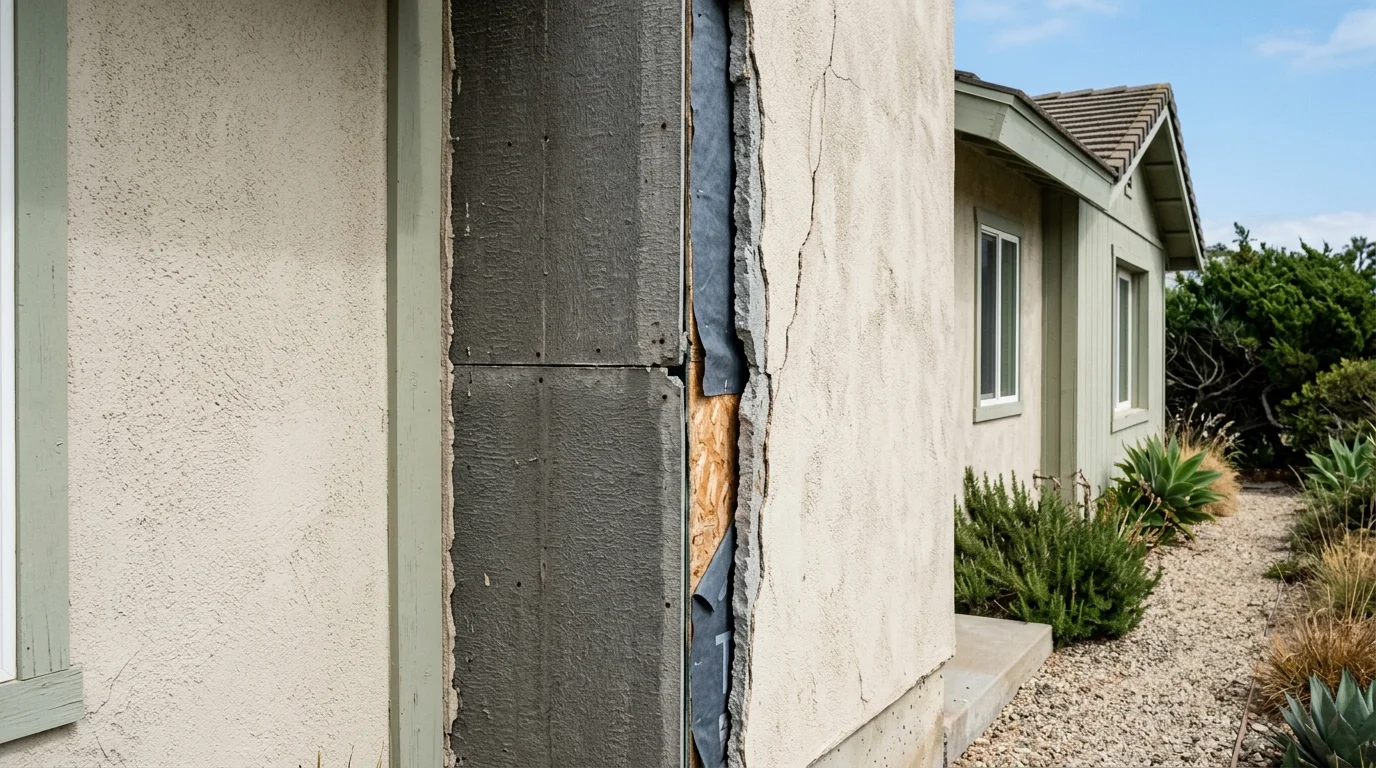
Why some San Diego additions use cement board under stucco
Remodelers reach for cement board when they want a stucco look on a small wall. You see it on ADUs behind bungalows in North Park. You see it on Mira Mesa garage conversions and Chula Vista second stories. The old house is already stucco. The new wall has to match from the street. Panels hang like sheathing. A base coat and finish go over them. The job reads as stucco when you drive by.
That is not the same choice as fiber-cement lap siding. Hardie-style cladding is a different product and a different look. If you are picking siding, not diagnosing a cracked addition, use our Hardie panel vs stucco comparison. This page stays on stucco already sitting on cement board.
Can stucco go directly on cement board. Some exterior systems are sold that way. A tile-backer sheet from a bath remodel is not that system. Interior board, the wrong screws, or a joint left as a dry seam will show later. Our claims file does not list an approved fastening schedule, joint treatment, or coat recipe for San Diego County. The matched pro and the building department have to confirm the listed wall.
On the coast, Encinitas and Imperial Beach walls sit in salt air and a wet marine layer. Inland, El Cajon and Escondido walls bake, then cool hard at night. An addition on a canyon lot in Tierrasanta or La Mesa also moves as soil dries. Cement board is stiff. The stucco on top is thinner than a keyed three-coat. Movement concentrates at the panel edges. That is why the new wing fails in a grid while the 1970s house next to it shows ordinary hairlines.
New construction stucco on a full house is still often a lath and plaster assembly. Cement board shows up more on the small, fast wall: the granny flat, the bump-out, the patched-in garage. If the finish already looks like the main house, the substrate underneath may not match at all.
Stucco is also not an insulation product. Treat energy claims on cement board stucco as unconfirmed. Ask the building department what the wall assembly has to meet. Do not treat a stucco coat as a substitute for listed insulation.
Where board joints, fasteners, and movement show through
The tell is a crack that follows a board. It runs straight, then turns at a right angle. Hairlines from ordinary stucco aging wander. Joint cracks look like a map of the panels. Fastener heads print as dots in a regular pattern, especially in afternoon sun on a west wall in Mission Valley or Santee.
Those marks are the board moving relative to the finish. Heat swells the panel. Night cooling shrinks it. Santa Ana winds dry the wall fast. Coastal fog wets it again. The finish cannot stretch across a hard seam the way a keyed coat can stretch across lath. The crack opens at the weakest line: the joint compound, the mesh edge, or the screw.
Moisture follows the same paths. Water that gets past a window horn in Pacific Beach, a deck ledger in La Jolla, or a roof-to-wall in Alpine does not stay on the face. It tracks along a board edge. Staining near grade, under a scupper, or at a hose bib is a drainage problem, not a color problem. The most serious exterior stucco problem is water that stays in the wall and reaches wood. Framing rot, swollen sheathing, and a musty smell at the base of an addition are the later stage. A surface patch will not stop that.
Downsides of cement board as a stucco substrate show up in that same pattern. Joints telegraph. Fasteners print. The wall is a set of plates, not a continuous keyed shell. A mixed wall, where the 1960s house is three-coat and the ADU is board, also cracks at the meeting line. That joint is two assemblies, two rates of movement, and often two flashings. Paint will hide it for a season. The line comes back.
Do not assume a coastal wall and an East County wall fail the same way. Encinitas holds damp longer. El Cajon cooks the finish and the screws. South Bay salt air attacks metal fasteners. If rust dots show through the coat, the fastener, not the color, is the story. A licensed pro has to open a test area before anyone promises a blend.
How this assembly differs from three-coat stucco over lath
Traditional stucco in San Diego is usually a water-resistive barrier, metal lath, then coats that key into the mesh. The scratch coat locks into the lath. Later coats lock into the scratch. The wall is one plastered shell. Our how stucco is installed walkthrough covers that stack. Coat thicknesses, weep screed height, and cure times are not in our verified claims file. Treat any number you hear on a job site as something the pro and the inspector still have to confirm.
Cement board stucco is a panel wall with a thinner cementitious skin. The board is the plane. Joints get tape or mesh in a base coat. A finish goes over that. There is no deep key into lath unless someone added lath on top of the board, which is a different assembly again. Two-coat versus three-coat stucco is the right comparison for plastered walls. It is the wrong comparison if your addition is sitting on cement board. You are looking at a substrate change, not just a coat count.
That difference matters when the wall fails. A three-coat crack can be a finish issue, a control-joint issue, or a lath issue. A cement board crack is often the panel joint printing through. Repairing the face without treating the joint puts the same line back in a year. If the board was never a listed exterior system, the honest repair may be to take the panels off and rebuild as a lath wall.
Do not copy a manufacturer time-savings pitch as a fact about your house. Labor claims, trip counts, and weather windows for specific brands are not verified here. What you can see on a San Diego addition is simpler. The board wall went up fast. The finish is thin. The house next to it, plastered over lath in the 1970s, moves as one shell. The addition moves as sheets.
If the long-term plan is a true plastered wall, that is lath replacement territory, not a color coat. The matched C-35 pro (lathing and plastering) has to say whether the board stays, comes off, or gets a listed overlay. We could not confirm a county-wide rule that one of those three is always required.
What a repair usually has to open up
A smear of finish over a grid crack is a cosmetic cover. It fails when the board moves again. A real repair starts by opening the finish along the joint, not by painting the line. The pro needs to see the tape, the fastener, and the board edge. If the board is soft, crumbling, or sitting on wet paper, the cut goes deeper.
What has to come off depends on what is wet. Sometimes the finish and base coat lift, the joint gets restated, and the face is recoated in a blend zone. Sometimes a full panel has to come out because water has been running the seam. Sometimes the water-resistive barrier behind the board is stained or gone. Then the repair is a wall rebuild, not a patch. Framing that is dark, punky, or moldy is a carpenter’s problem before any new stucco goes back.
Do not invent a square-foot price for that work. Quotes in San Diego vary with access, height, matching texture, and how much of the addition has to open. A first-person fee from this brand is not on the table. We match you with a licensed independent pro. That pro prices the opening they can actually see.
If the board assembly was never right for the exposure, the cleaner path is to remove it and rebuild over lath. That is the same decision as a failed barrier wall, not a color mismatch. Coastal moisture in Ocean Beach or Imperial Beach makes that call earlier. Inland heat in Ramona or Alpine makes the joint crack earlier. Either way, a closed-up wall that still weeps at the base needs drainage details the original addition may have skipped. Weep screed height and barrier laps are not verified in our claims file. The pro and the inspector confirm those on the opened wall.
A patch that traps moisture is worse than the crack you started with. Elastomeric paint over a wet joint seals the face and holds the water. Let the wall dry. Find the leak at the window, roof, or deck. Then rebuild the stucco as the listed assembly, not as a smear.
Questions to ask before covering or replacing the wall
Ask what substrate is actually on the addition. Cement board, foam, and three-coat lath can all wear the same color. A small test opening at a crack tells you more than a driveway guess. Ask whether the board is a listed exterior system or leftover interior board. If nobody can name the product, treat the wall as unconfirmed.
Ask the City of San Diego Development Services department what the opened wall needs if you are inside city limits. Unincorporated parcels go to the county building department. We could not confirm a single fastening or joint rule that covers every city in the county. The local counter, not a blog, sets the approved wall. If the house sits near wildland, check Cal Fire’s maps for a fire hazard zone. Never assume your lot is in or out of one. California Building Code Chapter 7A governs exterior walls in those mapped areas. Assembly specifics from that chapter are not in our claims file.
Ask whether the repair is a joint restatement or a rebuild over lath. Ask how the new work will meet the old house so the addition line does not become a new leak. Ask who pulls the permit if one is required. Stucco work in California is C-35 lathing and plastering work. Unlicensed contracting is a misdemeanor under Business and Professions Code 7028 unless an exemption applies. The small-job exemption is under $1,000 and no permit, both at once, effective January 1, 2026. Splitting a job to dodge licensing is excluded. Confirm the license on the CSLB lookup before anyone opens your wall.
On a home improvement contract, the down payment cannot exceed $1,000 or 10 percent of the contract, whichever is less. On a large rebuild that cap is $1,000, not 10 percent of the whole job. Do not pay a deposit that ignores that rule.
Skip the Hardie-versus-stucco debate if the stucco is already on the wall. That is a cladding choice for a future remodel. The live problem is the grid on this addition, the wet joint, and the assembly the inspector will accept when the face comes off.
When to call us
Call when cracks follow board lines, fastener heads print through, or an addition stains at the base after rain. That is licensed C-35 work on a wall that may need to open past the finish. Call us at (858) 400-4352 and we’ll connect you with a licensed local stucco contractor.