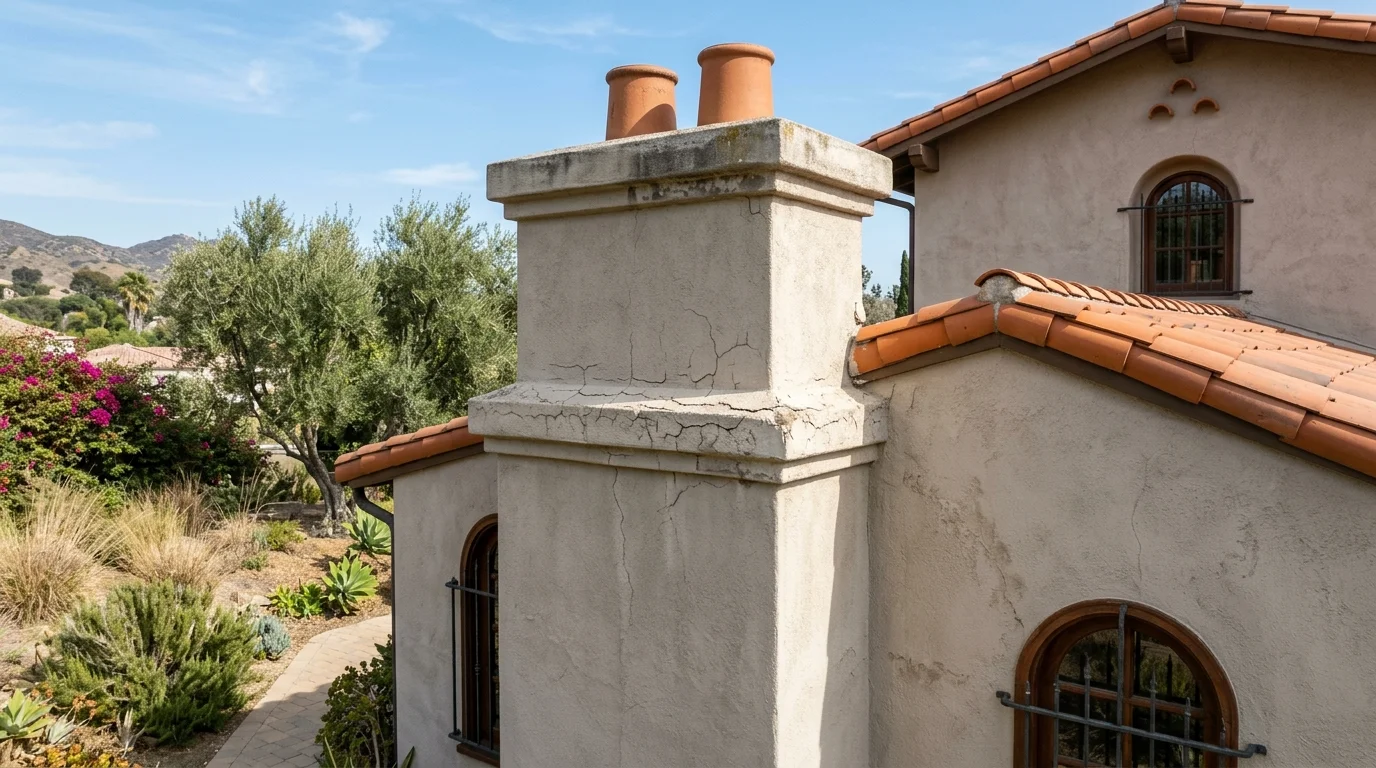
The chimney chase on a San Diego house takes weather from every direction. Walls get rain on one face. A chase gets sun, wind, and runoff on all four. When the cladding is EIFS (synthetic stucco, sometimes a Dryvit system), that extra exposure is why the chase often opens before the rest of the wall.
Why an EIFS chimney chase fails sooner than the rest of the wall
An EIFS chase is a framed box around the flue. Foam board, mesh, a base coat, and a finish coat wrap that box. It is cladding, not the chimney structure. Traditional cement stucco on a chimney is a different assembly. Mixing the two in a quote is how a homeowner gets the wrong repair.
The chase goes first because of geometry and San Diego weather. Coastal North County, from Encinitas through Carlsbad and into La Jolla, sits in marine layer for long stretches of late spring. May gray and June gloom leave the finish damp. Salt sits on every face. Inland, El Cajon, Santee, and Lakeside run hotter. Day-to-night swings move the foam and the finish. A chase has more corners per square foot than a long wall, so it moves in more places.
Then there is the roof. Water that hits tile or composition shingle has to turn at the chase. It hits the high side, runs the cheeks, and dumps at the low side. A wall at grade does not live in that much concentrated runoff. Hillside houses in Mount Soledad, Escondido, and Alpine also take wind-driven rain on the windward face. The leeward face can stay wet after the storm has passed.
None of that tells you, from the street, how the chase was built. Older barrier-style EIFS and later drainage-style systems are both in the county. Which one you have, and how it stops at the roof, is something a matched EIFS-capable pro has to confirm on site. That assembly is not something this page can verify from a photo or a listing.
A chase also has more edges. Caps, corners, and the line where cladding meets flashing age first. The field of a wall can look fine while those edges have already opened. That is the usual pattern behind an eifs chimney leak. It is not a mysterious failure of the whole system at once.
South Bay houses in Chula Vista and National City see a lot of marine moisture, same as the coast farther north. East County houses bake. The surface clues can look similar. Drying behind the foam does not. Treat the chase as its own elevation, not as a small piece of the front wall.
What surface damage around a chimney can and cannot show
Hairline cracks at the corners of the chase are common. So is finish that has pulled at a shoulder. A soft-looking bulge on one face, peeling texture, staining under the cap, and holes from impact all show on the surface. Those marks are real. They are not a moisture map.
You cannot diagnose hidden water in the foam or in the framing from a phone photo. Darker finish can be dirt, algae, or an old color mismatch. A crack can sit in the finish coat or it can go through mesh. A bulge can be foam movement, or it can be something behind the board. The honest next step is a close look by a licensed pro who works on EIFS, not a guess from the driveway.
What surface damage can show is where to start looking. Cracks that follow the corners often sit at foam joints. Cracks that fan from the flashing line often sit at a termination. Finish that is washing thin near the cap often sits in runoff. Soft spots you can press with a finger are a reason to stop pressing. Have the assembly opened in a controlled way. Do not keep probing.
What it cannot show is how far water has traveled. Water that enters at the cap can run inside the chase and show as a ceiling stain two rooms away. Water that enters at a roof-to-chase joint can wet sheathing while the finish still looks intact. That is why EIFS repair on a chimney is an inspection-first job. The how-to sequence for EIFS repair on a wall still applies in layers. A chase adds height, roofing, and four exposures the wall does not have.
Can EIFS be repaired? Yes, when the repair uses compatible layers and actually stops the water. A paint-and-caulk pass is not that repair. Neither is a cement smear on foam.
Where water usually enters at the cap, flashing, and shoulders
Most eifs chimney leak calls in this county cluster at three places: the cap, the flashing, and the shoulders.
The cap is the top of the chase. It is the first surface rain hits. If the cap cladding is cracked, open at a seam, or detailed so water sits, the chase fills from the top. Exact cap construction varies by house and by installer. Slope, metal, and how the EIFS returns at the top could not be confirmed as a single county rule. The matched pro confirms that detail on your chase. Do not assume a neighbor’s cap matches yours.
Flashing is the metal and sealant work where the chase meets the roof. That joint is a roofing detail and a cladding detail at the same time. Water that gets under tile or under a shingle course can travel along the chase before it shows. Kick-out and step details matter on a given roof, but the specific flashing profile on your house is not something this page can invent. If the roof and the EIFS were installed by different trades years apart, that joint is the first place to look. A stucco-only patch that leaves the flashing untouched often fails again.
Shoulders are the steps and corners where the chase changes width, or where it meets the roof plane. Finish is thinner at edges. Mesh has to wrap. Those are the spots that open with movement. Coastal fog does not have to be a storm. Slow wetting at a shoulder, week after week, is enough.
Waterproofing and moisture barrier work only helps if the entry path is actually in the scope. Sealing the finish and leaving a failed cap is a cosmetic pass. So is caulking a crack that is being fed from above.
If you smell gas, or you think the flue itself is involved, that is not an EIFS finish issue. Get the right trade. Use 911 if someone is in danger. SDG&E handles gas leaks. This brand matches cladding work. It does not work on the flue.
Permits are a local call. The City of San Diego Development Services department, or the building department for your city in the county, is who sets whether a given chase repair needs a permit. That could not be confirmed here as a blanket yes or no. If a permit is required, California’s small-job license exemption does not apply, even under $1,000. The threshold is $1,000 as of January 1, 2026, and both conditions must hold: under $1,000 and no permit. Check a contractor on the CSLB license lookup before you sign.
When a patch is the wrong repair on a chase
A patch is the wrong repair when it only closes the finish and leaves the water path open. That is the usual failure of a bucket-and-trowel visit on a chase.
It is the wrong repair when the product is cement stucco on an EIFS chase. Synthetic stucco chimney repair has to stay in the EIFS system. Foam, mesh, base coat, and finish are a stack. Cement patch on foam is a mismatch. Dryvit chimney repair, when the existing system is a Dryvit brand, should stay compatible with that system. Dryvit is one common brand, not the only one. The pro identifies what is on the house. Do not guess from color.
It is the wrong repair when the cap or flashing is still open. You can make the cheek look new and still have an eifs chimney leak after the next storm.
It is the wrong repair when foam is wet or crumbling and the bid is to skin over it. Opening a small window in the finish, in a controlled way, is how a pro sees whether the board is still sound. This page cannot tell you that from a picture. Neither can a visit that never leaves the yard.
It is the wrong repair when the job is split into tiny cash patches to stay under the license line. California law does not let someone dodge a contractor license by stacking sub-$1,000 contracts. Anyone who advertises as a contractor also loses that exemption at any price. Unlicensed contracting is a misdemeanor.
A tight, system-matched patch can be the right repair when the water path is found, the damaged foam and mesh are cut back to sound material, and the finish is rebuilt to the surrounding texture. That is a small EIFS repair, not a smear.
How much it costs could not be confirmed for this brand or for the county as a published average. Quotes vary with access, height, how much foam comes off, and whether a roofer has to be on the same job. Anyone publishing a starting-at number for your chase is guessing. Ask for a written scope instead.
Homeowners insurance is also not something this page can confirm. Whether a carrier pays for chimney repair depends on the policy and on whether the loss is sudden or wear. Call the carrier. Do not treat a blog as a coverage opinion.
How long EIFS should last could not be confirmed from a primary standard. Figures you will see online, including decades-long lifespan claims, are not verified here. Condition of the chase, the original install, and whether water was kept out matter more than a brochure number.
What a written EIFS chimney repair scope should include
A written EIFS chimney repair scope should name the chase as its own work area, not as “stucco patch as needed.”
It should list which faces will be opened, and whether the cap is in the bid. It should say who is responsible for roof flashing: the EIFS pro, a roofer, or both. If that line is missing, you do not have a complete job.
It should describe cut-back of damaged finish, mesh, and foam to sound material, then rebuild in compatible EIFS layers. It should not say “skim and paint” if the foam is in the work. Texture and color match belong in writing. So does whether the existing system can be identified (Dryvit or another brand) and which repair products will be used.
It should say how the pro will check for moisture in the assembly. The method is theirs to name. This page does not prescribe a test, because a single method could not be confirmed as required. “Looks dry” from the yard is not a method.
It should note access. Chimney chases are high. How the crew reaches the work is a safety and cost issue. Do not accept a vague plan to figure it out later.
It should state what is excluded. Flue, damper, spark arrestor, masonry crown (if there is one under or beside the EIFS), interior drywall, and roofing field work are common exclusions. Exclusions are fine when they are written. They are a problem when they show up after a rain.
If the contract is a home improvement contract, California caps the down payment at $1,000 or 10 percent of the contract amount, whichever is less. On a larger job that cap is $1,000, not 10 percent of the total. Confirm the contractor’s license on the CSLB site. Stucco Pro SD matches you with licensed independent pros. It does not hold the trade license, pull the permit, or warrant the physical work. The matched pro does.
For parcels that may sit in a wildland-urban interface or a fire hazard severity zone, do not take a blog’s word. Check Cal Fire’s maps and ask the local building department. Whether a given address is in a zone is a mapped determination. Specific Chapter 7A assembly rules are not confirmed here.
A complete scope is how synthetic stucco chimney repair stays a repair, instead of a yearly patch on the same corner.
When to call us
Call when the chase is cracking at the cap, the shoulders, or the roof line, or when you have a stain you cannot trace from the yard. A licensed independent stucco contractor, one who actually works on EIFS, has to see the assembly. Call us at (858) 400-4352 and we’ll connect you with a licensed local stucco contractor.