Orange rust along the bottom of a stucco wall is easy to treat like dirt. On a lot of San Diego County homes it is leftover stain on the plaster. On others the metal strip at the wall base, the weep screed, has started to corrode, and wiping the color will not put that flashing back.
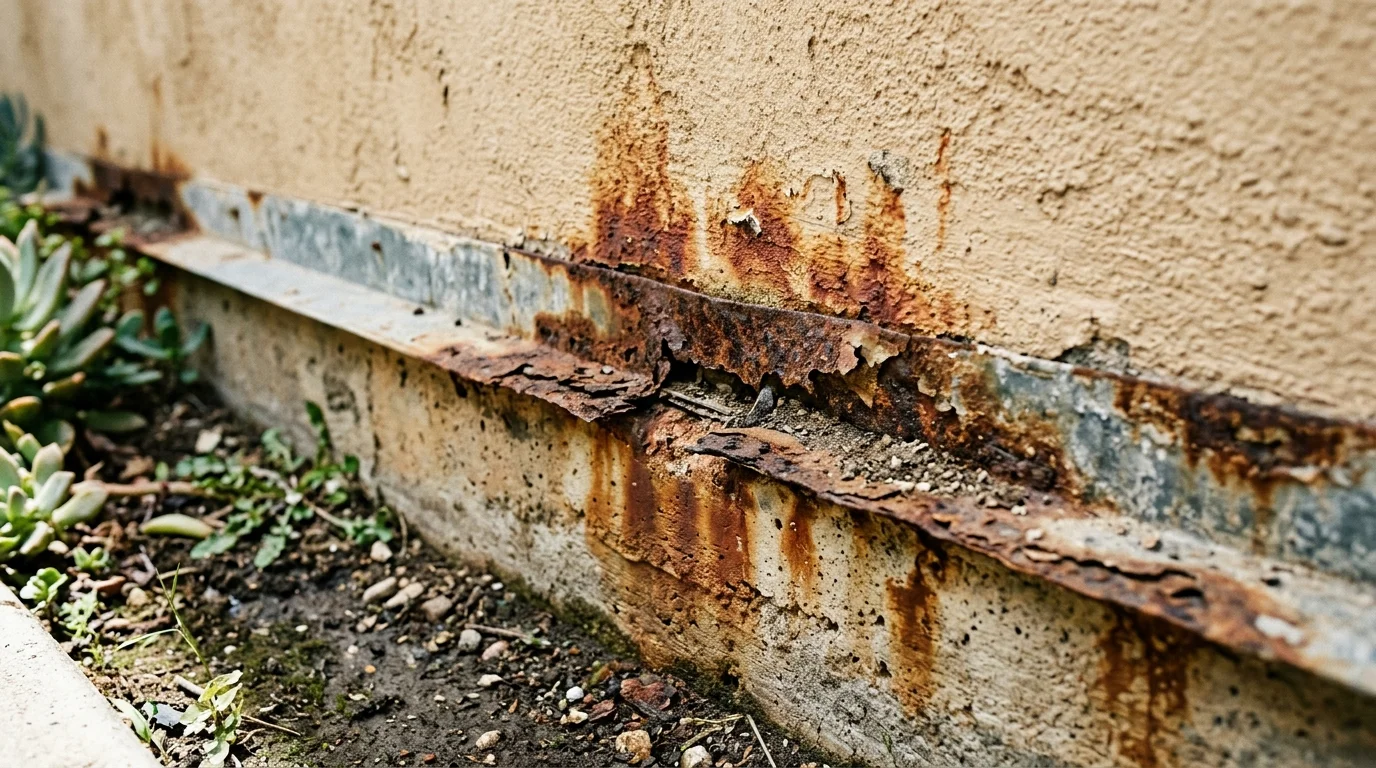
How rust and staining appear along the wall base
The weep screed sits at the bottom of a framed stucco wall. It stops the plaster and gives incidental moisture a path out. When that metal stays wet, orange and brown color shows up along the lower edge. Homeowners often search that look as rust at the bottom of a stucco wall.
Stain and failed metal are not the same thing. Rust-colored streaks can ride down from irrigation minerals, fertilizer, or old fasteners and leave color on the finish even when the screed is still intact. Confirmed metal damage looks different up close: flaking, holes, a lip you can crumble, or a gap where the profile used to be. You cannot settle that from a phone photo. A licensed local pro has to see the wall.
San Diego County is not one climate at the base of a house. Coastal walls in Imperial Beach, Pacific Beach, and La Jolla sit in salt air and a night marine layer that keeps metal damp even in a dry week. Inland walls in El Cajon, Santee, and Escondido take a different beating: summer sprinklers, clay soil piled into planter beds, and hardscape that was poured later against the original bottom edge. South Bay lots in Chula Vista and National City often get both salt and irrigation on the same elevation.
Where the color sits also tells you something. A narrow orange line right on the metal points at the accessory. Bloom that climbs a foot or more into the field, with soft or cracked plaster above it, is a different problem. That pattern belongs with stucco moisture damage on coastal walls, not with a wipe of the bottom strip.
Sprinklers that hit the wall every cycle are a common local source. So is soil, mulch, or a later patio slab that covers the drainage edge. Paint or caulk that sealed the openings shut can hold water in the channel. A short roof overhang on a west or south wall, typical on some mid-century tracts, just keeps more rain on that elevation. None of those causes are a diagnosis by themselves. They are reasons the metal has been wet.
Why surface cleaning doesn’t resolve damaged metal
People ask what removes rust from stucco because the stain is what they can reach. Cleaning can lighten orange color on the plaster face. It does not restore metal that has already pitted or perforated. If the accessory is still sound, stain removal is cosmetic. If the accessory is failing, the stain will come back, and the drainage path is already weaker than it looks.
A household rust remover, a pressure wash, or a coat of paint over the orange line does not count as rusted weep screed repair. Paint over active corrosion can hide the color and close the openings the screed is supposed to leave open. High-pressure washing can drive water into cracks at the base and scar the finish. Neither step tells you what is happening behind the lower edge.
The useful test is physical, not visual. Intact metal still has a defined profile and open drainage openings. Damaged stucco weep screed is thin, flaky, or missing in spots. You may see the plaster sitting with no termination under it. That is not a cleaning job. It is a wall-base inspection, then a scoped repair if the metal cannot do its work.
Do not treat recurring stain as a finish problem. If you cleaned the line last year and it is back after a wet week, moisture is still sitting at the base. The matched pro should look at irrigation, grade, and whether the openings are blocked before anyone talks about color coat. Cleaning first is fine when the goal is to see the metal clearly. It is not the repair.
If the only issue is mineral color on otherwise sound plaster, a licensed pro can say so after looking. If the metal is gone in sections, cleaning it is wasted time. The work then is to open the lower wall, confirm what is behind it, and replace the damaged run. That is a different scope from washing the stain off.
What must be checked behind the lower stucco edge
A weep screed is not trim you swap from the sidewalk. It sits under the lower plaster, tied to lath and the water-resistive barrier. When the metal is rusted through, the question is what else stayed wet. Photographs of the orange line cannot answer that.
A licensed stucco contractor should look at the screed itself, then at the materials stacked above it. That usually means the paper or wrap, the lath, and the wood at the sill once the lower plaster is opened. Reverse laps, torn barrier, or rusted lath change the repair. So does a wall that never had a working drainage path in the first place. The matched pro confirms the approved detail. This page does not.
Is a weep screed necessary? On a framed stucco wall it is the usual way moisture behind the plaster gets out at the bottom. Without an open path, water can sit at the base instead of leaving. That is the job described in our weep screed drainage guide for San Diego. This article is the next moment: visible rust, and whether that accessory still works.
Burial is the check a homeowner can start before anyone opens plaster. Soil, bark, and ivy against the wall in East County planter beds keep the metal wet. A patio or walk that was added later in Clairemont or North Park can bury the original edge in concrete. Paint or caulk across the openings does the same thing with a brush. Pulling mulch back is not a repair. It is how you see whether the screed is even there.
Irrigation is the other easy check. Watch a cycle on the elevation that stains. If heads soak the lower wall, the metal is getting a daily wet-dry load it was not meant to take. Adjusting spray does not rebuild perforated flashing. It does stop feeding the corrosion while a pro scopes the wall.
When the lower edge is opened, waterproofing and the moisture barrier are part of the same look. A new strip of metal with the old paper left reverse-lapped is not a confirmed fix. The barrier has to shed down and out. If it does not, replacing the screed alone can leave the wall leaking at the patch. Exact heights, coat thicknesses, and product specs are not confirmed here. The contractor who opens the wall is the one who matches the assembly to what the building department will accept.
When localized repair may be possible
Localized repair may be possible when the damage is confined, the barrier above still sheds the right way, and the rest of the run is sound. It is not something you can declare from the curb. A short rusty stretch under a hose bib is a different wall from a full elevation with soft plaster, interior dampness, or a screed that has disappeared under grade.
How to fix a weep screed, in practice, is not a surface patch. The lower plaster has to come off far enough to free the damaged metal, inspect what is behind it, and tie a new accessory into the existing barrier and lath. Then the base is rebuilt and the finish is matched. That sequence is why weep screed and foundation stucco is its own scope, not a caulk line.
Can you add a weep screed to existing stucco? Not as a slide-in strip from the outside. The new piece has to lap with the water-resistive barrier so water still drains down and out. Sticking metal on the face, or trying to tuck a profile behind intact plaster, does not create that path. On some older walls the larger problem is that the drain plane was never built. In that case a small accessory swap will not do what you want. The matched pro has to say which case you have after the lower edge is opened.
California contractor law applies to this work. Stucco is a licensed trade (CSLB C-35, lathing and plastering). Unlicensed contracting is a misdemeanor under Business and Professions Code section 7028, unless an exemption applies. The small-job exemption in B&P section 7048 is only for work under $1,000 in the aggregate (labor, materials, and everything else), that is casual or minor, and that does not need a building permit. Both the dollar cap and the no-permit condition have to hold. The $1,000 threshold is the figure in effect as of January 1, 2026. Splitting a job into smaller contracts to dodge licensing is excluded. Anyone who advertises as a contractor loses the exemption at any price.
If you sign a home improvement contract, the downpayment cannot exceed $1,000 or 10 percent of the contract amount, whichever is less. On a larger job that cap is $1,000, not 10 percent of the total. Confirm the contractor on the CSLB license check before you pay. If your city requires a permit to open the wall, ask the building department. For work inside the City of San Diego, start with Development Services. We could not confirm a single countywide permit rule for this repair, because each city sets its own trigger.
Do not treat this as a weekend DIY. Opening the base of a stucco wall can cut the barrier, the lath, or the sill if the cut is too deep. The brand does not perform that work. A licensed independent pro does, after they have seen the wall.
How to prevent the replacement detail from being buried
A new weep screed fails the same way the old one did if the bottom of the wall goes back under soil, bark, or a slab. The point of the replacement is an open drainage edge. Bury it, and you have paid to hide the next rust line.
Landscaping is the usual culprit inland. Planter beds in Vista, San Marcos, and El Cajon creep up the wall over a few seasons. Keep soil and mulch off the metal. If the grade cannot drop, that is a drainage conversation with the contractor, not a reason to pack dirt against new flashing.
Hardscape is the usual culprit on infill lots. A new walk, patio, or mow strip poured tight to the stucco can cover the openings. If a slab already buries the base, localized metal work may not be enough until the covering is cut back or the water is taken somewhere else. Exact clearance figures are not confirmed in our claims ledger, so this page will not invent them. The matched pro confirms the approved detail with the building department that has jurisdiction.
Do not paint or caulk the bottom edge shut after the patch. The screed is supposed to let water out. A tight paint film across the openings, or a bead of sealant “to keep bugs out,” recreates the trap. If the elevation needs paint, the painter has to keep those openings clear.
Irrigation should stay off the wall after the repair, especially on west and south sides that already take afternoon sun and sprinkler cycles. Roof and gutter issues that dump onto one elevation are worth fixing too, because a perfect screed cannot keep up with a wall that is soaked from above every storm.
Walk the base after the first heavy rain and after the first irrigation week. Look for new orange color, ponding against the wall, and anything that has drifted back over the metal. Catching burial early is cheaper than opening the plaster a second time.
When to call us
Call when the metal at the wall base is flaking, missing, or buried, or when rust stain keeps returning after you clean it. A licensed stucco contractor should open the lower edge, confirm what is behind it, and replace only what the wall actually needs. Call us at (858) 400-4352 and we’ll connect you with a licensed local stucco contractor.