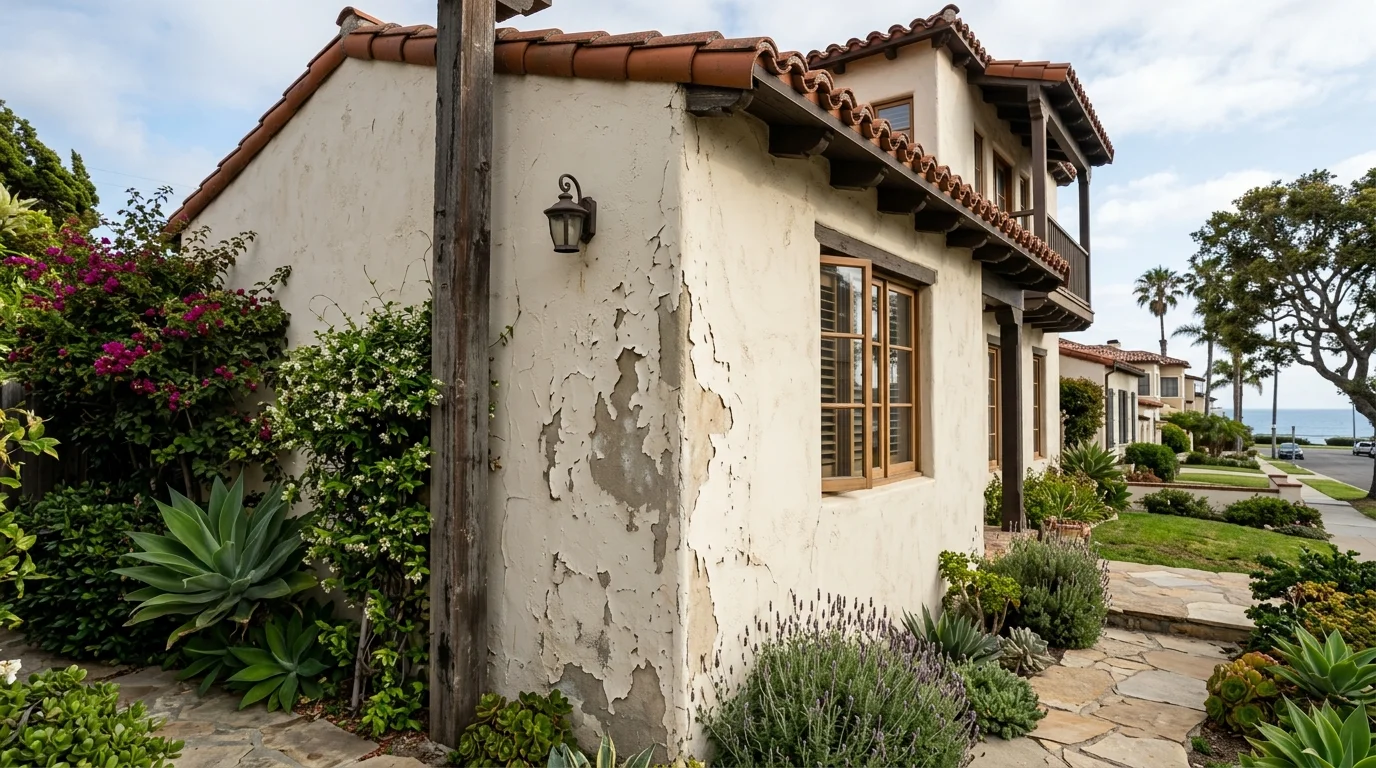
A Coronado stucco wall that is shedding paint is asking for a decision, not another coat. Paint over loose film and the next stretch of marine layer will lift it again. Stucco repair in Coronado belongs first, then prep, then color.
What peeling paint can and can’t reveal about the wall
Paint peels for a few different reasons. Some of them live in the coating. Some of them live in the stucco. A few live in the weather that hits this island every day.
On the Pacific side, salt and wind work the film. On the bay side, fog sits longer. Neither one, by itself, proves the plaster is failing.
Peeling can show that the last coat lost its grip. It can show too many layers stacked on a hard, chalky skin. It can show moisture leaving the wall and pushing the film off. It can show impact, a crack, or a patch that never bonded. That is useful. It is not a full diagnosis.
Peeling cannot show how wet the framing is. It cannot show whether the paper and lath are sound. It cannot tell you whether you need a small patch or a full re-stucco. It cannot prove a hidden leak at a window, a deck, or a roof edge. Flakes are a surface story. The wall has its own.
Coronado housing makes that gap real. Older cottages near Orange Avenue and the beach blocks often carry several paint generations. Mid-century houses closer to North Island may have a thinner system and more open sky. A Spanish-revival place on a quiet street can look fine from the sidewalk and still have failed film at the corners the marine layer never dries. The Silver Strand side takes wind and salt in a different mix than Glorietta Bay. Same city. Different walls.
Don’t treat flakes as a water-damage verdict. Don’t treat a clean scrape as a pass. The flakes tell you the surface is done holding. They don’t tell you what the plaster, the lath, or the wood are doing underneath.
A licensed C-35 contractor (lathing and plastering under California’s contractor board) is the person who should read the wall. A painter can talk about film. The stucco pro talks about the coats, the lath, and the path water takes. Those are different jobs. On this island they get mixed because people want the house to look ready for summer guests.
Walk the elevations that face the ocean and the ones that face the bay. Peeling that tracks a window head, a planter, or a roof scupper is a moisture clue. Peeling that is even, dusty, and all over a sunny wall is more often coating age. Clues. Not a verdict. Write them down before anyone bids a color.
How to separate coating failure from stucco damage
Start with your hands, not a color chip.
Press the paint. If it sheets off and the stucco under it is hard, even, and the same color as the rest of the field, you are looking at coating failure. If the plaster sands off with the paint, or the texture feels hollow, or a patch rings different from the field, you are looking at stucco damage. Those two paths do not get the same repair.
Look at crack shape. Fine mapped lines in a finish coat show up a lot on coastal stucco. Wide, stepped, or diagonal cracks that open and close with weather are a different conversation. Don’t guess which kind you have from the curb. Get close. Corners take the hit here. Wind-driven rain and salt collect at beads and at the returns around windows. If the paint is gone and the corner is soft, crumbly, or missing, that is not a primer problem.
Check where the wall meets the grade and where it meets a deck. Tight Coronado lots put irrigation, hose bibs, and planters right against stucco. Paint there often fails first. The plaster may be stained, eroded, or still sound. Only a close look tells you.
Synthetic systems (EIFS) and traditional cement stucco fail in different ways. If you are not sure which wall you have, say so on the bid walk. A pro who assumes cement stucco on an EIFS house will write the wrong scope.
Coating failure often wants exterior paint prep: scrape, feather, prime, and a coating the wall can actually hold. Stucco damage wants repair first. Sometimes both. The sequence is the whole point of prepping stucco for a repaint. Skip the repair and the new paint is a short lease.
A handyman can scrape loose paint. California law is stricter once the work is contracting. Under Business and Professions Code section 7048, unlicensed work is exempt only when the total price for labor, materials, and everything else is under $1,000, the work is casual and minor, and no building permit is required. That $1,000 figure is the one in force as of January 1, 2026. Older pages still say $500. That figure is stale. Both the dollar cap and the no-permit condition have to hold. Splitting a job to stay under $1,000 is not allowed. Anyone who advertises as a contractor loses the exemption at any price. Acting as a contractor without a license is a misdemeanor under section 7028. Check the license on the CSLB lookup before anyone touches the wall.
Don’t pick a coating from a brochure. Elastomeric products get sold hard on coastal houses. They can be the right film on the right wall, and the wrong film on a wet one. Read elastomeric paint on stucco after the wall is assessed, not before.
Where moisture checks fit before surface preparation
Prep that starts with a washer and a scraper is backwards if the wall is still wet.
Moisture checks belong before anyone commits to a coating. That does not mean a homeowner with a cheap meter has a diagnosis. It means the licensed pro should look for water’s path, then test where the clues point.
On Coronado, the usual paths are local and boring until they aren’t. Wind-driven rain off the Pacific. Fog that never burns off on bay elevations. Sprinklers on small lots. Clogged scuppers on flat-roof additions. Failed sealant at older windows. Planters built against stucco. Deck-to-wall joints on second stories that look at the Strand. A house two blocks from Orange Avenue can stay damp on the shaded side long after the sunny side looks dry.
A meter reading on the surface can lie. Salt and dense plaster confuse cheap meters. A dry afternoon after a week of June gloom can look fine and still hide wet sheathing. If a pro only waves a meter at the sunniest wall, ask them to come back to the shaded elevation and the base of the wall.
Look for stains, not just flakes. Dark runs under windows. Soft spots. Rust marks that hint at metal lath. Hollow areas. White salt on the face (efflorescence) is a moisture clue, not a paint color. If water is still entering, paint is a lid. Lids trap. The repair may need flashings, sealant, drainage, or, in bad cases, opening the wall. None of that is a weekend project, and none of it should be guessed from a photo.
Whether a given parcel sits in a wildland-urban interface or a high fire hazard severity zone is a mapped call. Don’t assume a Coronado lot is or isn’t in one. Cal Fire’s maps and the City of Coronado building department answer that. California Building Code Chapter 7A governs exterior walls in those mapped areas. The assembly details were not verified for this page, so a licensed pro and the city should speak to them if they apply.
Confirm permit questions with the City of Coronado. This page does not have a verified list of when a stucco repair needs a permit here. The city sets that. If a permit is required, the licensed contractor is the one who pulls it. This service does not.
When patching, stripping, or re-coating enters the scope
Three scopes get mixed on bids. They are not the same job.
Patching is local. A crack, a hole, a failed corner, a window return. The pro cuts to sound material, rebuilds the coats, and matches texture as close as the existing finish allows. Patching is the right call when the field is sound and the failures are islands.
Stripping is about the film. Loose paint has to come off or the next coat has nothing to hold. How far to go is a field call. Full strip versus scrape-and-feather depends on how many layers are on the house and how they are failing. This page cannot prescribe a method. Coronado’s older paint stacks are often the reason a “quick repaint” bid changes once the scraper hits the wall.
Re-coating the stucco, a re-stucco or a new finish coat over a sound base, is for widespread failure, worn texture, or a wall that will never take another paint layer cleanly. It is a different labor and material conversation. This brand does not quote that work. Independent licensed pros do, usually by the square foot, and the number moves with access, height, substrate, and finish. A house on a tight lot off Orange Avenue is not bid like an open yard in East County. Parking, staging, the bridge as the main link off the island, and HOA rules all change the day.
Do not let a bid say “repair as needed” with no map. Ask for elevations. Ask which corners. Ask whether the base coat is staying. Ask what happens if they open a hollow and find wet lath. Stucco repaint preparation in Coronado is that map, not a color chip.
A down payment on home improvement work in California cannot exceed $1,000 or 10 percent of the contract, whichever is less. On a large exterior, that cap is $1,000, not 10 percent of the whole job. Read the contract against that rule before you write a check.
If the wall is the wrong system, or the damage goes past the plaster, removal and rebuild can enter the talk. That is not the default for peeling paint on stucco. It is the end of a diagnosis, not the start of a pitch.
What Coronado homeowners should compare across proposals
People search for the best stucco company in Coronado when they want one thing: a licensed pro who will not paint a sick wall. Compare the paper, not the adjectives.
Check the license on the CSLB site. Stucco is C-35 work. A paint license is not a plastering license. The person who rebuilds the coats should be the plastering contractor. The person who coats after prep may be the same company or a separate trade. Get that in writing.
Compare scope, not a round number. Stucco work in San Diego County is typically quoted by the square foot or by elevation. It moves with access, height, substrate, and finish. No average belongs here because none was verified for this brand or this city. If a bid has no square footage, no elevations, and no list of openings, it is not a bid. It is a guess. That is the honest answer to “what to charge” and “how much does it cost”: the charge is the written scope, and the cost is whatever that licensed pro quotes after seeing your wall.
Ask what they will do with moisture. Who checks. What happens if they find wet material. Who owns flashings and sealant. Who talks to the City of Coronado if a permit applies.
Ask how they will leave the texture. A smooth Spanish house and a sand-finish ranch do not hide patches the same way. A sample on the shady side of the house is worth more than a promise.
Ask about sequence. Repair, dry, prep, then paint. If the bid starts with paint, the repair is an afterthought.
Access on this island is part of the job. Narrow streets, alley parking, HOA quiet hours, and Navy-adjacent neighborhoods all affect how a crew stages. A proposal that ignores that will slip. A proposal that names the elevations facing the Pacific versus the bay is paying attention.
This service matches you with licensed independent local pros. It does not hold a contractor license, does not send a crew, and does not warranty the work. The matched pro does. Use that to get more than one written scope, then pick the one that describes your wall.
When to call us
Call when the paint is peeling and you need a licensed stucco contractor to say what has to be repaired before anyone opens a can. That is the moment, not after a failed repaint. Call us at (858) 400-4352 and we’ll connect you with a licensed local stucco contractor.