Stucco removal cost can’t be pinned to one verified San Diego figure. The real decision is whether the wall needs a limited repair, a re-coat, or removal. Get each suitable option priced in writing after a licensed contractor inspects the wall.
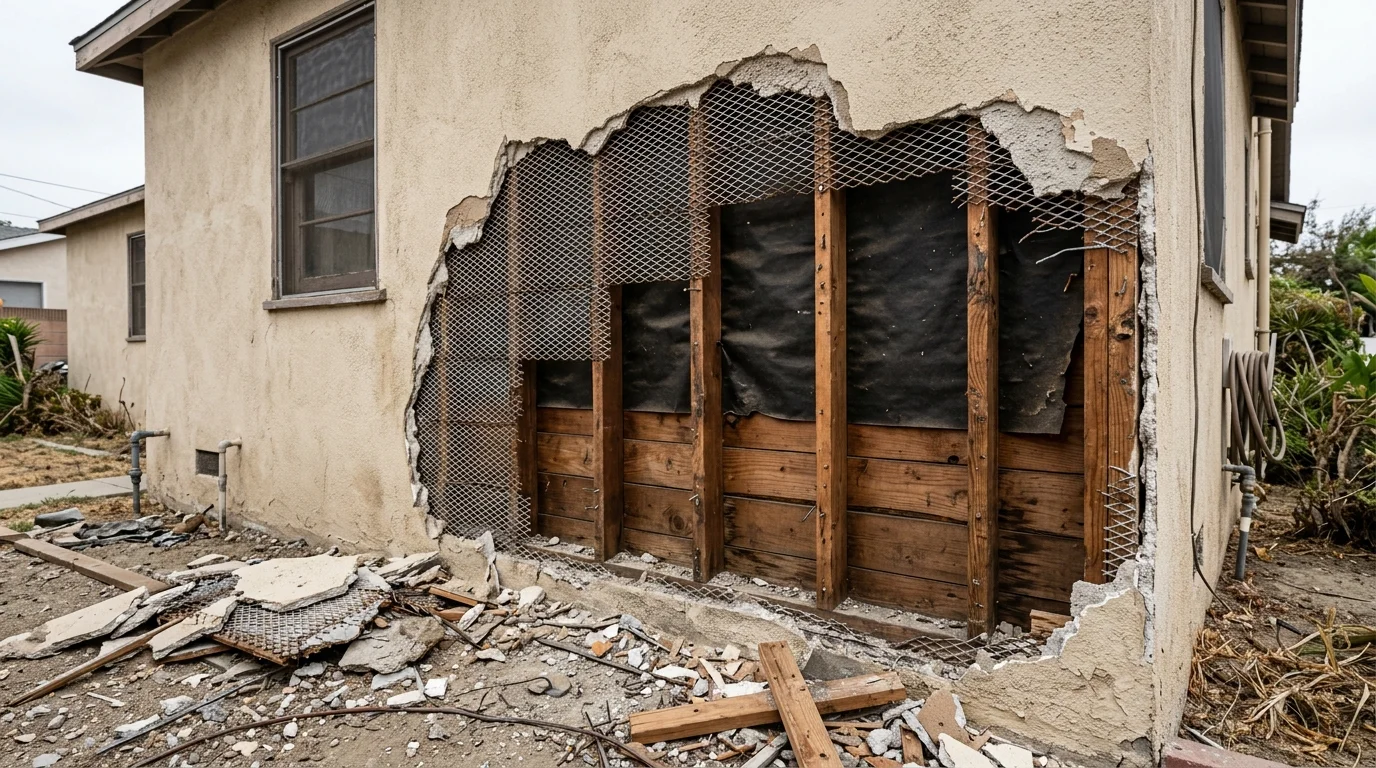
Repair, re-coat, remove: three different answers to the same complaint
A repair addresses a defined damaged area. A re-coat covers a broader surface and changes the visible finish. Removal takes off the existing stucco so the contractor can inspect and address concealed layers.
Those scopes aren’t interchangeable. A crack, stain, bulge, or loose area is only the visible complaint. The cause and its reach determine the appropriate response. That’s why a low removal quote isn’t automatically better than a higher repair quote. The contractors may be pricing different work.
Ask each contractor to label the proposed scope clearly. The proposal should identify which walls or sections are included. It should also state whether the price covers patching, re-coating, or complete removal in those areas.
San Diego County properties don’t share one standard condition. Coastal North County, inland North County, central San Diego, East County, and the South Bay have different exposure and housing patterns. The contractor should evaluate the actual wall, not price it from a city name alone.
Our guide to patching versus re-coating explains those two options in more detail. If neither option reaches the suspected problem, a stucco removal assessment may be the clearer next step.
What a re-coat can carry and what it cannot
A re-coat can make sense when the existing wall is a suitable base. It can address widespread finish concerns without opening every concealed layer. The contractor still needs to decide whether that base is sound enough for the proposed system.
A re-coat shouldn’t be treated as proof that everything behind the surface is intact. It covers the face of the wall. It doesn’t provide the same view that removal provides. If the concern involves lath, paper, framing, or concealed moisture, ask how the contractor ruled those issues in or out.
Get that reasoning in writing. A useful proposal explains what the contractor observed and what remains unknown. It should identify any testing or selective opening included before the final scope is set.
Also ask how adjoining walls, corners, doors, windows, and trim affect the plan. A finish change may look different when only one wall receives work. Texture and color transitions should appear in the proposal instead of being left for demolition day.
The key cost question isn’t simply, “Which option is cheaper?” It’s whether the proposed option addresses the suspected cause. Paying for a surface treatment that doesn’t reach the problem can create another decision later.
Signs the problem is behind the stucco, not in it
Surface appearance alone doesn’t settle the issue. Cracks, staining, bulges, softness, or hollow areas may justify closer investigation, but they don’t establish one cause by themselves. A licensed stucco contractor should interpret the pattern in person.
Look at where the symptoms appear. Note whether they gather around an opening, run along one wall, or return after earlier work. Record visible changes with dated photos. That gives contractors the same starting information and makes competing scopes easier to compare.
Tell the contractor about prior patches, paint, additions, window work, and known leaks. Don’t present a guess as a diagnosis. The history helps the contractor decide where closer inspection may be useful.
Ask what evidence supports removal. Then ask what evidence would support a smaller repair. A good written scope should connect the recommended work to observable conditions.
San Diego location matters at the inspection stage. A coastal Encinitas wall and an inland El Cajon wall shouldn’t receive copied assumptions. The contractor should consider the specific exposure, wall assembly, access, and repair history at that address.
Removal becomes easier to evaluate when the proposal names the uncertainty it is meant to resolve.
Failed lath, failed paper and failed framing
Lath, building paper, and framing sit behind the visible stucco. If a contractor suspects trouble within those layers, a surface patch may not provide enough access. Selective or broader removal lets the contractor see what is actually present.
Don’t accept a proposal that groups every concealed condition into “wall damage.” Ask which layer is suspected and how the contractor plans to confirm it. The distinction matters because each finding can change the work that follows.
For example, the proposal should explain whether the quoted removal stops at the exposed lath or includes taking out additional material. It should say who evaluates exposed framing and how newly discovered work will be authorized. Don’t assume that every hidden repair is included.
If lath replacement is anticipated, compare the removal proposal with the stated lath replacement scope. The documents should agree about boundaries, disposal, replacement work, finish restoration, and excluded items.
No one can responsibly price unseen conditions as though they’ve already been confirmed. That doesn’t make the quote useless. It means the base scope, allowances, exclusions, and change-order process need to be clear before the wall is opened.
Water damage that has been running for years
A stain may be recent, recurring, or left from an older event. Its appearance doesn’t reveal a reliable timeline. Avoid proposals that assign an age or cause without supporting evidence.
Start by identifying what is known. Note where the stain appears, when you first noticed it, and whether it changes after weather or water use. Share any records from earlier roof, window, plumbing, or exterior work. The stucco contractor can then explain whether removal is needed to inspect the affected area.
The removal scope should have boundaries. Ask where opening will begin and what conditions would justify extending it. That keeps a focused investigation from quietly becoming an undefined wall demolition.
The proposal should also separate source correction from wall restoration. A stucco contractor may identify visible clues, but another licensed trade may need to evaluate work outside the stucco scope. Get responsibilities assigned before reconstruction begins.
Don’t cover an unexplained condition only because the visible surface can be made uniform. First establish what the contractor found, what remains unknown, and whether another professional must inspect the exposed area.
Delamination and hollow-sounding areas
A contractor may tap or otherwise inspect a wall while looking for areas that behave differently. A hollow sound can guide further evaluation, but homeowners shouldn’t treat one sound as a complete diagnosis.
Ask the contractor to mark the areas of concern. Then request an explanation of how those areas affect the proposed boundary. Scattered spots may lead to a different scope than a broad connected area. The proposal should show that distinction.
Also ask what happens at the edge of removal. The written scope should explain how the contractor will decide where to stop once the work begins. That decision shouldn’t depend on an undefined verbal understanding.
Visible movement, loose sections, and prior patch edges should also be documented. Photos attached to the proposal can help both parties understand the starting condition. They’re especially useful when several elevations have similar textures.
Removal cost follows the actual scope, not the homeowner’s description alone. Ask for separate pricing when a contractor can reasonably distinguish a limited opening from a larger removal area. You’ll then know which amount applies before any expansion is approved.
What removal exposes and why that is the point
Removal is investigative as well as physical. It allows the contractor to see layers that a finished wall conceals. That view can confirm the expected scope, narrow it, or reveal a different condition.
Before work starts, ask what the contractor expects to expose. The proposal should name the planned depth and area. It should also explain how openings will be protected while decisions are pending.
Documentation matters here. Request photos after the stucco comes off and before concealed work is covered. Ask the contractor to identify each newly observed condition in plain language. You should be able to connect a proposed change with a specific finding.
This is also the moment to confirm whether another trade needs access. Don’t let one contractor’s scope imply responsibility for work that hasn’t been assigned. Separate evaluations and approvals can keep the record clear.
The value of removal isn’t simply that old material disappears. Its value is access to evidence. That’s why the opening plan, inspection point, and decision process belong in the contract. Without those details, demolition can begin before everyone agrees on what the opening is meant to answer.
The scope creep nobody warns you about
Removal can reveal conditions that weren’t visible during the first inspection. That possibility should be handled in the contract, not improvised after demolition begins.
Ask for a base scope with exact boundaries. Then ask how added work will be priced and approved. A written change order should describe the new condition, added work, price adjustment, and schedule impact before that added work proceeds.
Watch for vague phrases such as “repair as needed.” They don’t tell you what is included. Replace them with measurable areas, named wall sections, or another boundary both parties understand. Photos or marked elevations can help.
Separate necessary restoration from optional appearance work. One price might cover reopening and rebuilding the affected area. Another might cover broader finish work intended to reduce a visible transition. Those are different decisions.
Access can also alter a proposal. A tight side yard in central San Diego may require a different plan than an open wall elsewhere in the county. The contractor should inspect the actual path, staging area, landscaping, and nearby surfaces before finalizing the scope.
The safest comparison is line by line. Make sure every bidder is pricing the same removal boundary, exposed-layer response, disposal responsibility, and finish endpoint.
Disposal, dust and the neighbors
Stucco removal creates debris and disturbs the work area. The contract should explain who handles containment, daily cleanup, final cleanup, hauling, and lawful disposal. Don’t assume those tasks are included because demolition appears on the estimate.
Ask how the contractor will protect windows, doors, landscaping, paving, outdoor equipment, and adjoining finishes. Protection should match the property. A South Bay side yard, an East County lot, and a closely spaced central-city home may need different staging plans.
Discuss access before materials arrive. Identify gates, driveways, shared paths, parking constraints, and surfaces that shouldn’t carry equipment. If a neighbor’s property could be affected, settle access and communication before work begins.
Working hours and local requirements can vary by address. Confirm current rules with the city or county that issues permits where you live. Don’t rely on a schedule copied from another San Diego County project.
The proposal should also state what remains at the end of each workday. Ask how open wall areas, stored materials, and loose debris will be handled. These details don’t produce a universal removal price, but they explain why two apparently similar bids may cover different responsibilities.
Getting a scope in writing before demolition starts
A usable removal proposal tells you what comes off, where it comes off, and what happens next. It should identify included elevations or wall sections, the removal boundary, protection, cleanup, hauling, inspections, reconstruction, finish work, and exclusions.
Ask for separate lines where the scope can split. Removal, concealed repairs, lath work, finish restoration, painting, and work by other trades shouldn’t blur into one unexplained total. You need to know which finding activates each charge.
Confirm permit responsibility with the city or county that issues permits for the property. Requirements depend on the actual project and address, so don’t rely on another homeowner’s experience. The contract should state who will handle any required permit.
Verify the contractor through the CSLB license check. California’s minor-work exemption applies only when the aggregate contract price is under $1,000, the work is casual or minor, and no building permit is required. The exemption doesn’t apply to someone advertising as a contractor, and a larger job can’t be split into smaller contracts to avoid licensing.
For a home improvement contract, the down payment can’t exceed $1,000 or 10 percent of the contract amount, whichever is less. Review the payment schedule alongside the work milestones.
Finally, require written approval for changes. Stucco removal cost becomes much easier to manage when discoveries, decisions, and added work leave a clear paper trail.
When to call us
Call when a patch or re-coat won’t answer concerns about concealed wall conditions. This kind of evaluation needs a licensed stucco pro who can inspect the property and define the removal scope. Call us at (858) 400-4352 and we’ll connect you with a licensed local stucco contractor.