Finding EIFS repair contractors near you takes more than comparing bids. The right contractor should identify the wall system, investigate moisture, and explain the repair before cutting anything open.
Why EIFS work is not the same skill as stucco work
EIFS and traditional stucco can look similar from the sidewalk. Their layers, materials, and repair methods aren’t interchangeable.
Traditional stucco commonly uses cement plaster over lath. EIFS is a layered wall system that may include insulation board, reinforcing mesh, base coat, and a textured finish. Openings, joints, penetrations, and transitions are part of the diagnosis.
That difference matters when someone repairs a crack or soft area. A surface patch might hide the symptom without identifying what happened beneath it. The contractor needs to understand the outer finish and the layers behind it.
Ask candidates how often they diagnose and repair EIFS specifically. Follow with questions about the materials they expect to find. A clear answer should describe an assembly, not just a coating.
Our guide to what EIFS is and how it differs from stucco can help you recognize the vocabulary. You don’t need to become an installer. You only need enough context to notice when a bidder treats every textured wall alike.
That distinction matters across San Diego County. A wall near the North County coast may have a different exposure history than one in El Cajon. The contractor should inspect the property in front of them, not rely on a standard answer.
The first question to ask, and the answer that ends the conversation
Start with one direct question: What type of wall system is this, and how will you confirm it?
A capable contractor should explain what they’ll inspect before naming a repair. They may discuss wall thickness, exposed edges, original plans, product markings, penetrations, or a small investigative opening. The method will depend on the building and damage.
Stop the conversation if the answer treats EIFS as ordinary stucco without qualification. The same applies when someone identifies a proprietary system from appearance alone. Texture and color don’t confirm every layer behind the finish.
Listen for a process instead of instant certainty. The contractor should separate what they can see from what still needs investigation. They should also explain whether their initial opinion could change after testing or limited removal.
This question works because it reveals how the candidate thinks. EIFS repair requires diagnosis before material selection. A bidder who can’t explain that sequence may be pricing an assumption rather than the wall.
Whether they identify the system before quoting
A useful quote begins with system identification. Without it, the contractor can’t clearly define compatible repair materials or the layers included in the work.
Ask the bidder to write down what they believe is installed. The description should be more specific than synthetic stucco. It should identify the system type when possible and note any facts that remain unconfirmed.
Original construction records may help, but records and existing walls don’t always tell the same story. Prior alterations can introduce different finishes, sealants, patches, or accessories. The contractor should compare available documents with visible conditions.
The quote should also distinguish inspection from final repair. If concealed conditions remain unknown, the scope can explain how those conditions will be evaluated. It should state how changes will be documented and approved.
This is especially important when comparing contractors from different parts of San Diego County. A photo-based assumption can miss details found only at the property. Look for a bidder who examines windows, doors, roof-to-wall areas, fixtures, and other transitions connected to the damaged section.
Barrier versus drainage: a contractor who does not ask has not looked
Barrier EIFS and drainage EIFS manage water differently. A barrier system depends heavily on its exterior surface and sealed transitions. A drainage system includes a path intended to let incidental water move behind the outer layers.
The contractor should determine which approach appears to be present. That answer affects the inspection, repair boundaries, and details around openings. It also affects what must be preserved or restored during the work.
Be cautious when a bidder never discusses drainage. The same concern applies when someone assumes every older-looking wall is a barrier system. Appearance alone doesn’t settle the question.
Ask how the contractor will examine the bottom edge, penetrations, windows, and transitions. Their answer should connect visible details to the suspected assembly. If a section can’t be confirmed without opening the wall, that limitation belongs in the quote.
A careful contractor may revise the scope after limited investigation. That isn’t automatically a problem. A clearly stated unknown is more useful than confidence unsupported by inspection.
Moisture testing before demolition, not after
Moisture investigation should help guide removal. Waiting until the wall is open can turn a planned repair into an undefined demolition job.
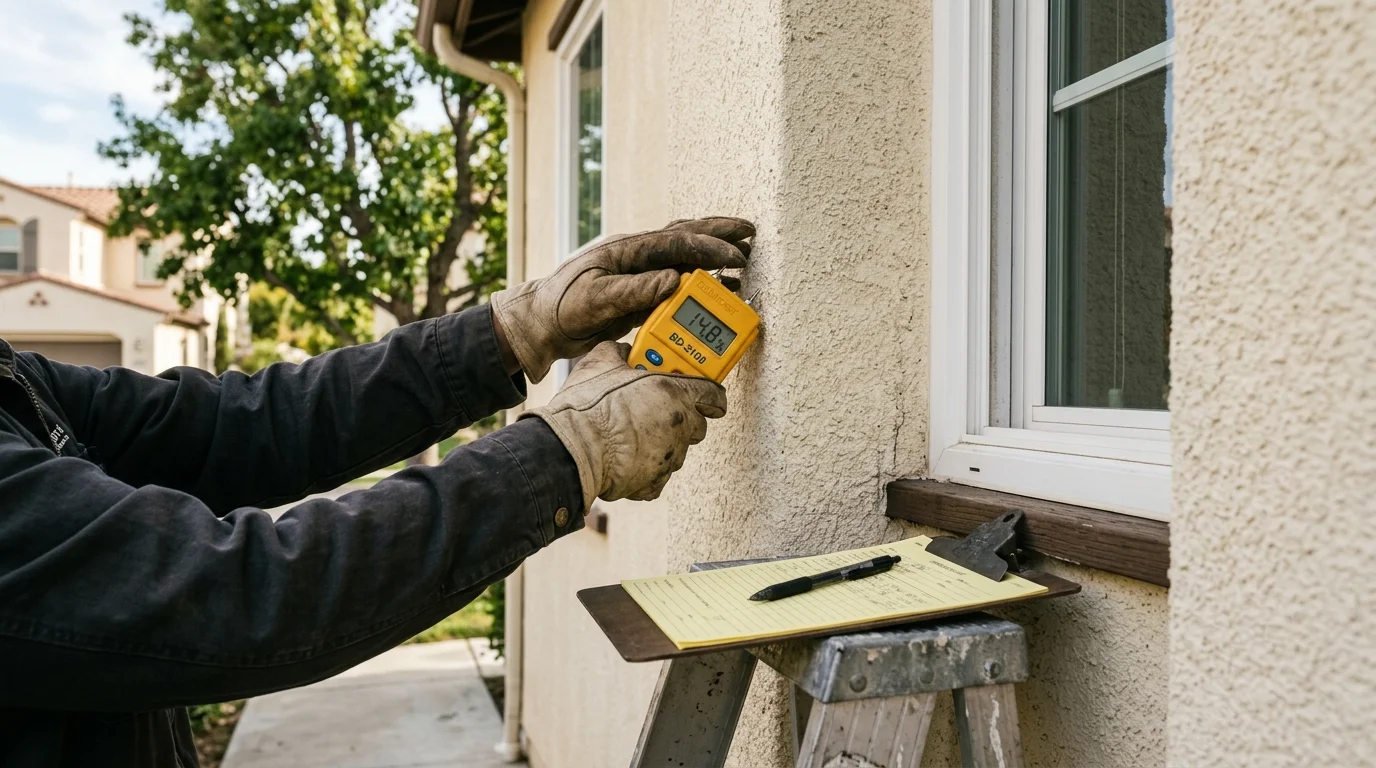
Ask what testing method the contractor proposes and why. A surface meter can help screen an area. Probe testing may provide information from beneath the finish when used in appropriate locations. Each method has limits, so readings need context.
Testing should cover more than the visible stain or crack. The contractor should explain how they choose locations around windows, doors, joints, penetrations, and adjacent wall areas. You should also know whether holes will be sealed after testing.
No single reading explains an entire wall. Ask for a simple record of locations and findings. Photos, a marked elevation, or written notes can make later scope discussions clearer.
The goal isn’t to collect the most readings. It’s to define what appears affected and what remains uncertain. That information helps the contractor set repair boundaries while avoiding unnecessary removal.
Our EIFS repair service connects San Diego County homeowners with licensed local pros who can inspect the wall and propose an appropriate scope.
How they describe the finish match
An EIFS patch can be sound and still look conspicuous. Finish matching deserves its own conversation before work begins.
Ask the contractor to describe the existing texture, color, aggregate, and application pattern. If the wall has an acrylic finish, the proposed materials should be identified. The contractor should explain how they’ll compare a sample with the existing surface.
Color alone isn’t enough. Texture depth, tool movement, patch shape, and surrounding weathering affect the result. San Diego’s direct sunlight can make small texture differences easier to notice across broad wall areas.
Be wary of an absolute promise that a localized patch will disappear. Ask what level of variation may remain and whether the repair should stop at a corner, joint, trim line, or another natural break.
The written scope should say whether finish work covers only the patch or a larger section. It should also address preparation around earlier coatings or repairs. That gives you a fair comparison between bids that may otherwise appear similar.
Manufacturer training and what it does and does not prove
Manufacturer training can show that a contractor has studied a particular system. It doesn’t replace a current California contractor license, a site inspection, or a written diagnosis.
Ask to see the training documentation. Note the manufacturer, course, participant, and date shown. If the credential matters to your decision, confirm it directly with the organization that issued it.
Then bring the conversation back to your wall. A certificate doesn’t identify concealed moisture, damaged sheathing, or previous repairs. The contractor still needs to explain the inspection and proposed work.
Training may be most relevant when the existing system can be identified. Ask whether the proposed repair materials come from that manufacturer or are represented as compatible. Request product names in the scope rather than accepting a general reference to EIFS materials.
Don’t confuse manufacturer recognition with government licensing. They answer different questions. One concerns product or system instruction. The other concerns the contractor’s legal status and classification in California.
Checking a California license and what the classification means
Check every candidate through the official CSLB license lookup. Search the business or individual named on your proposed contract. Compare the displayed name, status, and classification with the paperwork you received.
Stucco work falls under California’s C-35 lathing and plastering classification. That classification doesn’t prove specialized EIFS experience. You still need the system, testing, and finish questions covered here.
California’s minor-work exemption is narrow. Beginning January 1, 2026, it applies only when the aggregate contract price is less than $1,000, the work is casual and minor, and no building permit is required. Splitting work into smaller contracts doesn’t create the exemption. Someone advertising as a contractor also loses it at any price.
Permit requirements depend on the work and the jurisdiction. A contractor working in San Diego, Encinitas, El Cajon, or Chula Vista shouldn’t give one blanket answer. Confirm the current requirement with the city or county that issues permits for your address.
For broader hiring checks, read our guide to hiring a stucco contractor in San Diego.
Red flags: a same-day quote, no probe, no talk of the sheathing
Speed isn’t the problem. An EIFS quote becomes concerning when it arrives before anyone identifies the system, investigates moisture, or discusses concealed layers.
A probe isn’t required in every situation. Still, the contractor should explain whether deeper testing is needed and what another method can confirm. Dismissing moisture investigation without a reason leaves a major question unanswered.
Listen for discussion of the substrate or sheathing behind the EIFS. The contractor doesn’t need to predict concealed damage. They should explain how suspected damage will be evaluated and what happens if removal reveals different conditions.
Other warning signs include an undefined patch area, unnamed materials, and a promise of an invisible match without a sample. Watch for bids that omit windows, sealant joints, penetrations, or nearby transitions from the inspection discussion.
A careful proposal can include uncertainties. It should identify them plainly and establish a process for changes. That protects you from comparing a narrow surface patch with a scope that includes investigation and restoration of affected layers.
What a written EIFS scope should actually spell out
The scope should identify the wall system or state that identification remains pending. It should list the areas inspected, testing method, proposed repair limits, and conditions that could change those limits.
Look for the layers included in removal and replacement. The document should address the substrate or sheathing if damage is discovered. It should name the proposed base, reinforcing material, finish, sealant, and related accessories where applicable.
Openings and penetrations need clear treatment. The scope should identify which windows, doors, fixtures, joints, or transitions are included. It should also say whether adjacent finishes will remain untouched or receive a broader finish application.
Ask how concealed conditions will be documented. Changes should be described and approved before added work begins. The contractor should also state who will determine whether a permit is needed for the final scope.
Payment terms belong in the contract. For a California home improvement contract, the down payment can’t exceed $1,000 or 10 percent of the contract amount, whichever is less. Any contractor warranty should be written as the contractor’s obligation, not ours.
Finally, compare exclusions as carefully as inclusions. A shorter bid may exclude testing, finish blending, sealant, or concealed repairs. Price alone won’t show those differences.
When to call us
Call when EIFS damage may involve moisture, concealed layers, or a finish that needs careful matching. Call us at (858) 400-4352 and we’ll connect you with a licensed local stucco contractor.