A corner crack on a Mission Road storefront is not automatically a patch. Commercial stucco repair in Fallbrook goes wrong when a bid prices a square of finish and skips whether that elevation is already moving, wet, or a different wall system. Write the scope first, then compare the stucco contractor, not the other way around.
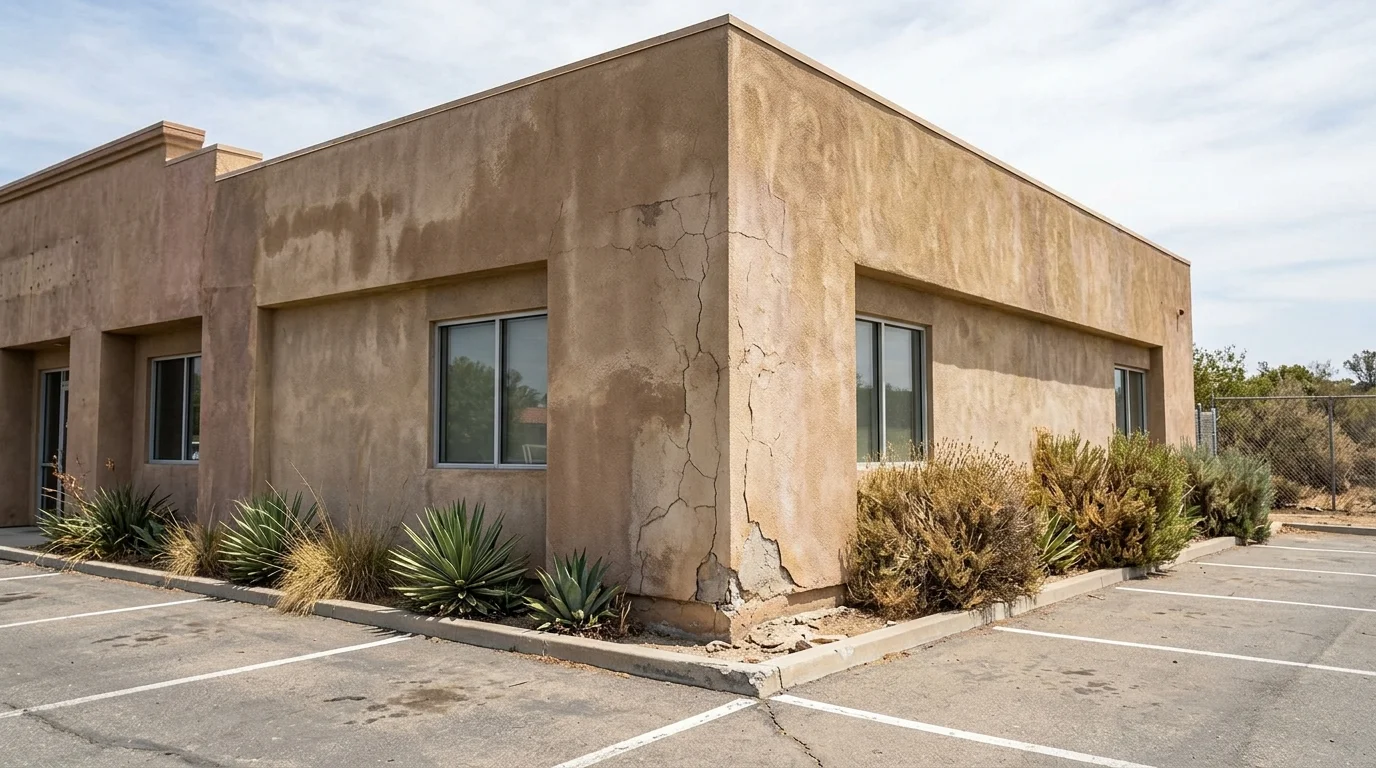
How to separate isolated damage from an elevation-wide problem
Fallbrook sits inland in northern San Diego County, up the I-15 and Pala Road corridor from the coast. West and south walls take harder sun than Encinitas or Carlsbad. Nights cool off. That daily swing opens hairline cracks that a coastal fog belt does not stress the same way. Grove irrigation, parking-lot spray, and splash at grade keep lower walls wet long after a winter storm has passed. El Cajon is also inland, but Fallbrook’s commercial stock sits closer to planted hillsides, De Luz canyons, and agricultural water. A stain at one scupper can sit next to a whole elevation that is already chalked and mapped.
Isolated damage has a cause you can point at. A cart hit at a loading door. One failed window head. A ladder scrape on an alley elevation off Main Avenue. The stucco around it should still ring hard, hold the same hardness, and show the same finish. Cracks should not repeat across bays or jump control joints in a pattern. If the only failure is at that opening or that corner, stucco patching can be a fair scope, as long as the bid names the patch limits in writing.
Elevation-wide trouble looks quieter until you walk the wall. Map cracking across a bay. Hollow or soft spots along a floor line. Color that has faded evenly, so a tight patch will read as a rectangle forever. Rust streaks at fasteners. Repeating leaks at several openings on the same face. When those signs stack up, a patch quote is not a repair plan. It is a placeholder.
Do not let a contractor price only what you can see from the parking lot. Ask for a wall-by-wall note: which elevations are in, which are out, and why. Photograph each elevation in even light, including the Reche Road or East Mission sides that tenants never photograph. Then read those notes against the countywide commercial guide on repair versus recoat for San Diego commercial stucco. Fallbrook still needs that same decision. The local difference is heat, irrigation, and occupied storefronts, not a different trade.
If the finish is foam-backed or the wall feels springy, stop calling it cement stucco. Synthetic systems (often sold as EIFS) do not patch like three-coat work. Confirm the system before anyone writes quantities. A handyman who treats both as the same mud is not doing commercial stucco Fallbrook owners can defend later.
What occupied properties change about access and protection
Occupied commercial work is a logistics job that happens to include plaster. A vacant warehouse off Reche Road is not a tenanted strip on Mission Road. The matched pro still has to reach the wall. You still have to keep people, glass, and inventory out of the mess.
Write access into the scope the way you would write a tenant memo. Which elevations face public sidewalk. Which face an alley, a drive aisle, or a grove edge. Where lifts can sit without blocking fire lanes or ADA paths. Where dumpsters, condensers, and camera mounts already crowd the wall. Fallbrook’s older downtown parcels are tight. Rural commercial parcels along South Mission or Pala can take equipment, but they also pick up dust, irrigation overspray, and slope.
Protection belongs in the same paragraph, not as a verbal “we’ll be careful.” Name storefront glass, door hardware, rooftop units that dump condensate down a wall, lighted signs, and any coating or mural you intend to keep. Name walkway covers and after-hours work as a coordination item, not a promise of speed. Stucco Pro SD does not dispatch crews and does not quote arrival windows. The licensed independent pro you hire sets the work hours with you and the tenants.
Occupied buildings also change water and dust control. Washdown that is fine on an empty lot will sheet toward a shop entrance. Containment that is skipped on a rear elevation will put grit on cars along Main Avenue. If the bid is silent on protection, the low number is incomplete.
Ask who talks to tenants, who posts notices, and who restores irrigation heads pulled away from the wall. Grove-adjacent and landscaped lots in Winterwarm, Morro Hills, and Live Oak Park-area commercial sites throw water at stucco all year. If sprinklers go back to hitting the patch, the repair was theater.
Permit rules for a given commercial patch in unincorporated Fallbrook were not confirmed against County of San Diego building records for this page. Do not assume City of San Diego Development Services is your counter. Fallbrook is county land. Have the licensed pro and the property manager ask the County what, if anything, the elevation work triggers before quantities are treated as final.
Where moisture checks fit before repair quantities are set
Quantities written before a moisture check are guesses. Inland north county rain is seasonal. Irrigation is not. A west wall that looks dry at noon can still be feeding a stain from a clogged scupper, a failed sealant joint, a planter, or grade that slopes toward the plaster.
Walk the wet path, not just the crack. Roof-to-wall metal. Overflow at canopies. Window and door perimeters. Hose bibs and condensate lines. Splash at sidewalks along Mission. Weep and drainage details at the base of the wall matter, but specific weep-screed heights and coat thicknesses are not verified in our claims ledger, so they do not belong in a bid as invented numbers. What does belong is a plain finding: where water is getting in, whether the stucco is still bonded, and whether the repair stops at finish or has to open the wall.
Hollow sound, staining, and rust at fasteners are reasons to open a test area, not reasons to skin the whole elevation on day one. If wood or metal behind the finish is involved, lath and substrate work has to show up as an allowance or a unit price, not as a surprise after demolition. If nobody has checked, nobody has a quantity.
Do not treat a wildland-urban interface map as a stucco spec. California regulates exterior walls in mapped fire-hazard areas under Building Code Chapter 7A, administered with Cal Fire and the State Fire Marshal. Whether a Fallbrook parcel in De Luz, Rainbow, or the planted hills is in a severity zone is a mapped call, not something a writer or a salesperson should assert. Check Cal Fire’s maps and the County building department for that address. Assembly details from Chapter 7A are not verified here, so they stay off this page.
Moisture findings should change three lines on the bid: square footage in, square footage out, and what is excluded until openings are made. That is the same measurement logic laid out in how stucco jobs are measured and bid. Fallbrook commercial work still lives or dies on those lines.
How texture and color standards belong in the scope
A structurally honest patch that reads as a rectangle is still a failed commercial elevation. Texture and color are not punch-list taste. They are part of the scope.
Name the existing finish in writing. Sand, lace, dash, or smooth. Cement color coat or paint over stucco. If the building has mixed eras, Mission-facing bays and rear additions often do, specify each elevation. Texture matching has to include a sample on the actual wall, in the actual sun, not a bucket lid in a shop.
Fallbrook’s inland UV fades west and south walls faster than a shaded north alley. A fresh patch mixed to an old chip will still flash when the rest of the elevation is oxidized. The scope should say how far the finish extends past the repair: blend, panel, or full elevation coat. If the bid only patches the hole, you bought a map of every repair.
Do not accept “it will blend” as a standard. Require a held sample, a named product line if one is known, and a note on whether color coat or paint is the finish. Lifespan claims for stucco are not verified in our ledger, so ignore “this will last X years” language. Judge the sample and the blend area instead.
Synthetic finishes need their own texture plan. Do not let a cement dash get burned onto an EIFS wall because it was cheaper. Confirm the system, then match that system.
What property owners should compare across bids
Compare scopes, not slogans. “Best stucco company Fallbrook” copy does not tell you whether two numbers describe the same wall.
Line up every bid on the same elevations, the same openings, and the same exclusions. Isolated patch versus elevation work. Moisture findings, or a written statement that none were done. Access, protection, and tenant coordination. Texture sample and blend limits. What happens if lath or sheathing is rotten once the finish comes off.
Then check the license. Stucco is CSLB C-35 (lathing and plastering). Look the number up on the CSLB license check. Do not use a third-party lookup. In California, acting as a contractor without a license is a misdemeanor unless an exemption applies (Business and Professions Code §7028). The small-job exemption in §7048 is only for work under $1,000 in the aggregate, effective January 1, 2026, that is casual or minor and does not need a permit. Splitting a commercial elevation into sub-$1,000 tickets to dodge licensing is excluded. Anyone who advertises as a contractor loses the exemption at any price. A handyman flyer is not a commercial stucco plan.
Stucco Pro SD matches property owners with licensed, independent local pros. We do not hold the trade license, we do not pull permits, and we do not do the plaster work. The pro you hire does. We also do not publish prices, waivers, or “free estimate” policies on this page. Commercial stucco work in San Diego County is quoted from measured scope, access, substrate, and finish. If a bid is silent on those, it is not cheaper. It is unfinished.
Skip testimonials and star counts as a deciding tool. They are not how you buy this work. Walk the elevation, read the exclusions, confirm the license, and keep the County in the loop on permits. That is how commercial stucco Fallbrook owners keep two bids from describing two different buildings.
When to call us
Call when an occupied Fallbrook commercial wall needs a licensed C-35 pro, not a patch quote written from the parking lot. Isolated damage, elevation-wide failure, and mixed cement or synthetic systems all start with a written scope. Call us at (858) 400-4352 and we’ll connect you with a licensed local stucco contractor.