A stained or damp-looking stucco wall doesn’t automatically need a coating. Stucco isn’t a stand-alone waterproof layer, so the right decision depends on the drainage details behind and around it. A good stucco waterproofing company will diagnose the water path before recommending a surface product.
The thing most people get wrong: stucco is not waterproof and never was
Stucco is an exterior finish, not a sealed shell. It can shed much of the rain that reaches it, but the wall still needs a way to manage water that passes through cracks, joints, and openings.
That distinction matters when someone offers to “waterproof” the wall. A coating may reduce how much rain reaches the finish. It can’t correct every problem behind the stucco. It also can’t replace missing or damaged drainage details.
Start by asking what the contractor believes is failing. Is water entering through a window joint? Is there an open penetration? Is the lower drainage edge blocked? Is the surface unusually absorbent but otherwise sound? Those conditions don’t call for the same repair.
The answer also depends on the wall itself. A traditional stucco assembly and an EIFS wall aren’t inspected or repaired the same way. An older wall may also contain previous patches and coatings that affect the next step.
The useful question isn’t simply whether stucco needs waterproofing. Ask what path the water follows and which part of the wall should stop or drain it.
How a stucco wall is designed to handle water it lets through
A stucco wall should be considered as an assembly. The visible finish is only one part. Behind it, the wall may include drainage materials, lath, flashing, and connections around openings.
Those components need to work together. Water that reaches the back of the finish needs a route downward and outward. Caulk and coating can support that system in the right places. They shouldn’t be treated as substitutes for it.
This is where local inspection matters. Coastal North County, inland North County, central San Diego, East County, and the South Bay don’t present identical exposure. A wall in Encinitas shouldn’t receive an automatic recommendation copied from a wall in El Cajon. Orientation, shade, openings, prior repairs, and surrounding surfaces also change what the contractor should inspect.
A stucco waterproofing company should trace the suspected route instead of judging the wall from one stain. That can mean checking the area above the damage, nearby windows, roof-to-wall connections, mounted fixtures, and the bottom edge.
Our waterproofing and moisture barrier service connects San Diego County homeowners with licensed independent pros who can inspect those conditions.
The water-resistive barrier behind the wall and what it does
The water-resistive barrier sits behind the visible stucco in many wall assemblies. Its job is different from paint or sealer. It helps manage water after that water gets behind the exterior finish.
You usually can’t judge that barrier by looking at the middle of an intact wall. The contractor may need to inspect exposed edges, nearby openings, or a carefully selected area. Existing records can also help identify how the wall was built.
Damage near a window doesn’t automatically prove the entire barrier has failed. The source may be a local transition, joint, or penetration. A broad coating proposal can miss that distinction.
Ask the contractor to explain what was observed and what remains uncertain. If opening the wall is recommended, ask where and why. If the barrier is damaged, ask how the proposed repair will connect with the surrounding material. That connection matters more than a vague promise to “seal everything.”
Requirements can vary with the property and repair scope. The specific rule for a San Diego address couldn’t be confirmed from appearance alone. Ask the city or county that issues permits where you live whether the proposed work requires approval or inspection.
Weep screed, flashing and the drainage path out
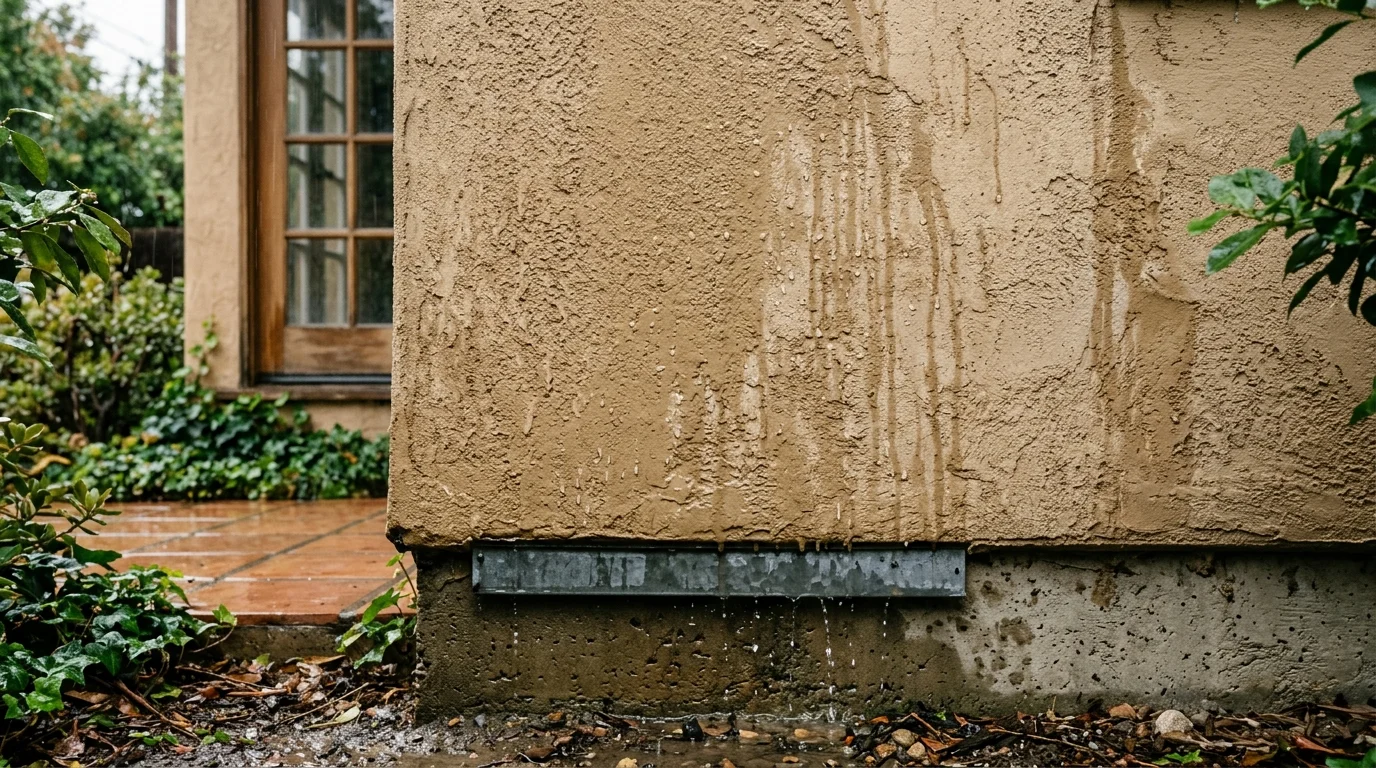
Water management needs an exit. At the lower edge of many stucco walls, a weep screed helps provide that drainage path. Flashing directs water at transitions, openings, and places where different building surfaces meet.
These details are easy to overlook because they aren’t decorative. They can be partly hidden by landscaping, paving, paint, patching, or later construction. A surface coating won’t reopen a blocked exit or rebuild an improper transition.
Look for staining near the base, damaged edges, sealed drainage openings, or stucco that continues into surrounding materials without a clear break. Those observations don’t diagnose the wall by themselves. They give a licensed contractor specific areas to examine.
Our guide to weep screed and stucco drainage in San Diego explains that component in more detail. It also helps homeowners understand why repairing the bottom of a wall can involve more than covering a visible crack.
Don’t rely on a universal measurement copied from another project. The correct detail couldn’t be confirmed for your property without examining its assembly. Ask the contractor to identify the applicable requirement and confirm it with your local building department.
What a surface waterproofing product can honestly do
A surface product can change how the stucco face handles rain. Depending on the wall and product, it may reduce surface absorption and bridge very small surface irregularities. It may also provide a new color or more uniform appearance.
That’s useful only when the product matches the problem. A coating can’t rebuild a failed barrier, correct missing flashing, or repair an open joint around a window. It won’t explain why the wall became wet.
Before choosing a product, ask what substrate it accepts. Existing paint, chalky material, repairs, dirt, and incompatible coatings can affect the result. The contractor should also address cracks and failed joints before applying the finish.
Be cautious with the word “waterproof.” Ask whether the proposal concerns surface water resistance, joint sealing, drainage repair, or replacement of concealed materials. Those are different scopes.
No universal product or application schedule could be confirmed for every San Diego stucco wall. Product requirements come from the manufacturer, while permit questions belong to the city or county serving the property. A licensed contractor should connect those instructions to the actual wall condition.
Where a sealer helps and where it traps moisture and makes things worse
A clear or penetrating sealer may be considered when the stucco surface is sound and the concern is surface absorption. That doesn’t make it an automatic choice for every unpainted wall.
The contractor first needs to understand how moisture enters and leaves the assembly. Applying a product without that diagnosis can change the wall’s drying behavior. If water continues entering through a joint or concealed defect, a less-permeable surface may make the underlying problem harder to see.
Previous coatings matter too. A clear sealer intended for bare mineral stucco may not suit a painted or heavily patched surface. Mixing systems without checking compatibility can cause adhesion or appearance problems.
Ask for the exact product name and written instructions. The proposal should explain preparation, compatible surfaces, repair steps, and expected maintenance without making unsupported lifespan promises.
Dark staining, bubbling, peeling, or recurring dampness deserves investigation before another layer is added. Those signs don’t prove that a sealer trapped moisture. They do show that the wall needs more than a quick visual recommendation.
If the source remains uncertain, pause the coating decision. Finding the entry point is usually more useful than adding another surface layer.
Elastomeric coatings and the trade-off nobody explains
Elastomeric coating is often presented as the broad answer for cracked stucco. Its flexibility can make it appealing on walls with small surface movement. The trade-off is that a thicker coating also changes how the wall handles moisture and future repairs.
That doesn’t make elastomeric coating good or bad by itself. The condition of the wall, existing coatings, crack pattern, drainage details, and product instructions all matter. Open joints and active damage still need direct attention.
Preparation is a major part of the decision. Loose material, incompatible paint, failed patches, and damp areas can undermine the coating. Texture is another concern. A heavy application may change the look of fine or detailed finishes.
Read our guide to elastomeric paint on stucco before comparing proposals. It explains the product-specific questions that deserve clear answers.
Ask each contractor why elastomeric coating suits your wall better than a breathable coating, targeted repair, or no coating. The answer should refer to observed conditions. It shouldn’t rest on a blanket claim that every stucco wall needs to be sealed.
Penetrations: the places water actually gets in
Windows, doors, pipes, vents, lights, railings, hose connections, and mounted hardware interrupt the wall surface. Each interruption deserves attention during a moisture inspection.
The visible crack may not be the entry point. Water can appear below or beside the place where it entered. That’s why coating only the stained area often fails to answer the larger question.
Inspect changes in material and shape. Look where stucco meets frames, trim, roofing, decks, walls, and utility components. Note missing sealant, separated joints, rust staining, loose fixtures, and patches with open edges. Don’t remove mounted equipment or open the wall unless the work is appropriate for you and the property.
A licensed stucco contractor can determine which conditions belong within the stucco scope. Some leaks may involve windows, roofing, plumbing, or another trade. A useful proposal should identify those limits instead of pretending one coating solves every source.
For stucco work, confirm the contractor’s license through the official CSLB license check. Stucco falls under the C-35 lathing and plastering classification.
Signs the barrier behind the wall has already failed
Surface symptoms can justify a closer inspection, but they don’t reveal the full condition alone. Watch for recurring interior dampness near an exterior wall, persistent staining, soft or loose stucco, bubbling coatings, corrosion marks, and damage that returns after patching.
Location adds context. A mark below a window points the inspection toward different details than damage concentrated at the wall base. Several isolated areas may also have separate causes.
Photograph the condition before cleaning or repainting it. Include wide views and close details. Note what happened before the mark appeared, such as rain, irrigation, plumbing work, window replacement, or exterior mounting. That record helps the contractor compare possible routes.
Testing methods and the need to open the wall depend on its construction. No single inspection method could be confirmed as correct for every property. Ask what the proposed test can establish, what it can’t establish, and whether access will require a repair afterward.
If concealed damage is found, request a written scope that separates removal, barrier work, lath work, stucco replacement, texture matching, and coating. Clear scope makes competing proposals easier to compare.
Deciding between coating the surface and fixing the detail
Choose the repair by matching it to the observed failure. A sound wall with a surface absorption concern may lead to a coating discussion. An open joint may need targeted sealing and surrounding repair. Damaged flashing, drainage, or concealed barrier materials call for work at that detail.
Sometimes both paths belong in the same project. The contractor may repair the entry point first, then prepare and coat the broader wall for a consistent finish. Sequence matters because a finished surface can hide areas that still need access.
Ask for photographs and plain explanations. The proposal should identify the suspected source, repair boundaries, materials, preparation, and responsibility for adjacent components. It should also state what remains unknown until the wall is opened.
Don’t choose solely by which proposal covers the largest area. A broad coating can be unnecessary when the problem is local. A small patch can be inadequate when the concealed assembly is damaged.
Confirm permit requirements with the city or county that issues permits for your address. Then verify the contractor’s license and compare the scopes line by line. That process gives you a stronger basis for choosing a stucco waterproofing company than a product name alone.
When to call us
Call when staining returns, coatings bubble, joints open, or the water path isn’t clear. Those conditions need a licensed stucco pro to inspect the wall and explain whether surface treatment or detail repair fits.
Call us at (858) 400-4352 and we’ll connect you with a licensed local stucco contractor.