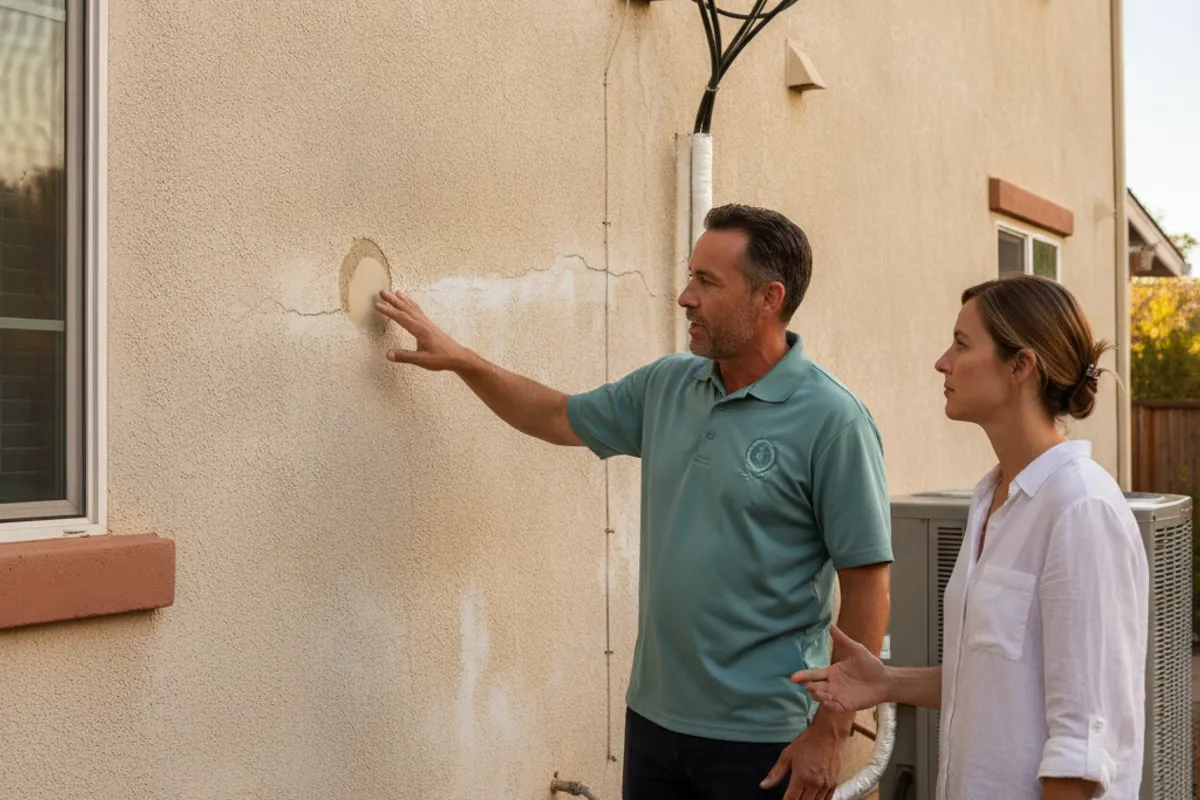
Repairing EIFS requires cutting back the damaged area to sound foam, lapping new fiberglass mesh into the existing layer, and applying a matched finish coat. Traditional stucco patches won’t work on synthetic systems. Cement over foam fails to bond and cracks quickly. Proper EIFS repair focuses on sealing out water and restoring the continuous mesh layer.
Why EIFS repair is different from traditional stucco
Synthetic stucco relies on a layered structure of insulation board, base coat, fiberglass mesh, and an acrylic finish. You can’t patch an Exterior Insulation and Finish System (EIFS) like a traditional hard-coat stucco wall. Standard cement patching material won’t bond properly to the exposed foam. The patch will fail and fall out. If you have a synthetic stucco exterior, the repair must use compatible acrylic materials and follow a specific sequence.
Diagnosing the real damage first
Surface damage on EIFS often hides a larger moisture problem. Water gets trapped behind the foam board and rots the wood sheathing underneath. The crews we match you with start by finding the edge of the damage. They tap the wall to map out hollow spots where the base coat has delaminated from the foam. They also probe the perimeters around windows and doors. Finding moisture behind the insulation means the repair must go deeper than the surface.
The step-by-step repair sequence
A lasting EIFS patch rebuilds every layer of the system.
- Cut back the damaged area: The crew removes the loose or broken layers to expose sound material. They cut the finish coat back further than the base coat. This creates a stepped edge.
- Assess the substrate: Once the wall is open, they check the sheathing for water damage. Wet wood gets replaced before any new foam goes on.
- Replace the insulation board: New foam board is cut to fit the hole and attached to the wall.
- Apply base coat and lap the mesh: This is the most vital step. The crew applies a new base coat and embeds fresh fiberglass mesh. This new mesh must overlap the existing mesh by several inches. If the mesh lap is skipped, a crack will form exactly at the seam.
- Apply the finish coat: A new acrylic finish goes over the patched area to seal the system.
Matching texture and color
Blending a new patch into an old wall takes skill. An acrylic finish coat ages and fades under UV light. A fresh bucket of the original factory color will look too bright on a five-year-old wall. The pros we connect you with use custom tints to match the faded wall. A patch that looks perfect when wet will often dry to a different shade. The crew tests the color and texture on a sample board, lets it cure, and checks the match before applying it to your home.
Sealant joints and terminations
Most EIFS failures start at the edges. Water enters where the synthetic stucco meets a window, a door frame, or a roofline. These terminations require specialized elastomeric sealants. Standard caulking dries out and separates from the acrylic finish. Maintaining these sealant joints prevents water from getting behind the foam and causing structural damage.
What you can fix and when to call a pro
Homeowners can handle minor surface maintenance. You can safely touch up small chips in the finish coat or replace aging sealant around a window.
You should avoid any repair that breaks through the base coat and exposes the foam. Don’t attempt DIY repairs at window perimeters or areas with suspected moisture behind the wall. These jobs require opening the system and managing water intrusion. If your wall needs structural patching, reach out to schedule an EIFS repair. You can also read more about specific brand systems in our Dryvit repair guide.
Frequently asked questions
Can you patch EIFS with regular stucco?
No. Standard cement stucco won’t bond to the foam board or acrylic base coat used in an EIFS wall. The patch will quickly crack and fall away.
How do you fix a hole in synthetic stucco?
You must cut back the damaged layers, replace the foam board, and apply a new base coat. The new fiberglass mesh must overlap the old mesh before the final finish coat is applied.
Can water damage behind EIFS be repaired?
Yes. The damaged foam and wet wood sheathing must be completely removed. Once the structural wood is replaced and dried, the synthetic stucco layers are rebuilt from the substrate up.
Why do EIFS patches crack at the edges?
Patches crack when the new fiberglass mesh isn’t lapped into the existing wall mesh. The system relies on continuous mesh for strength, so a butt joint will always separate.