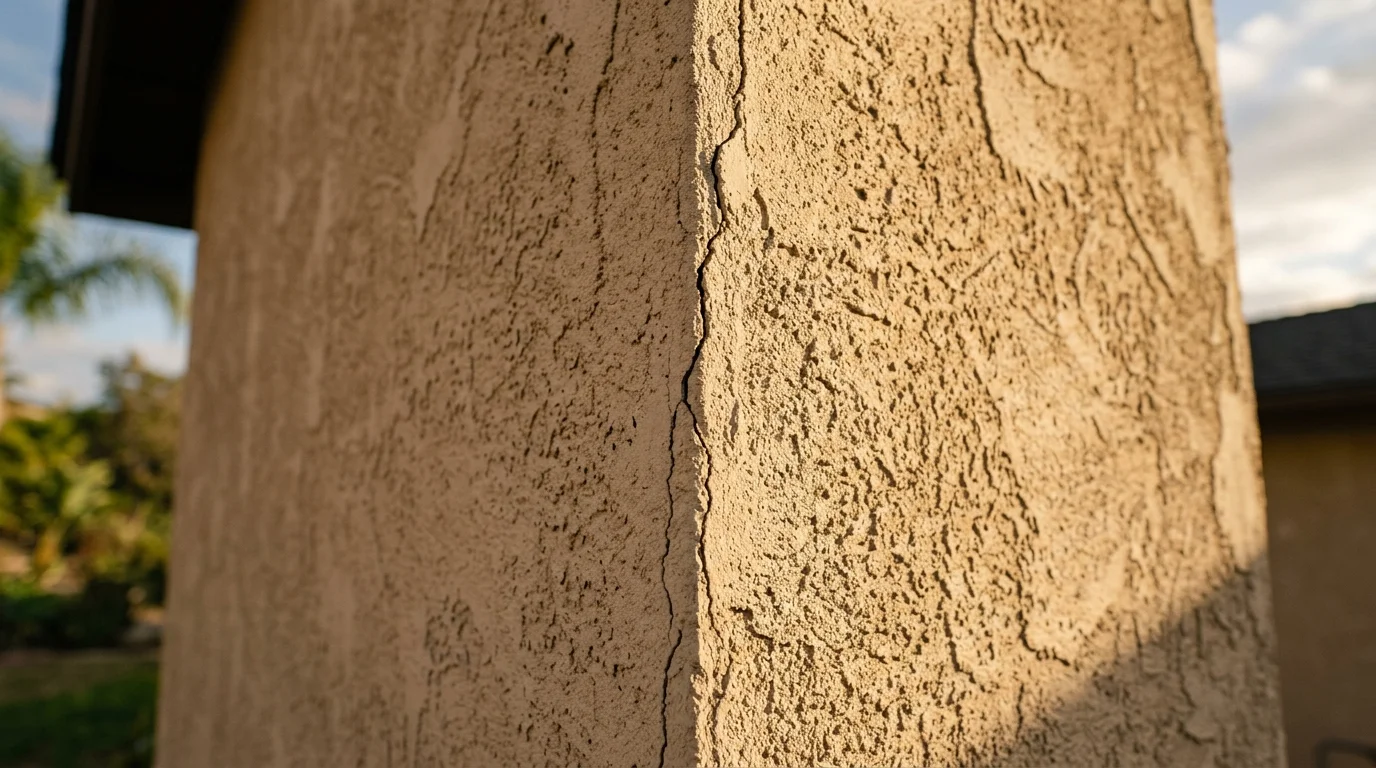
A stucco corner bead forms the straight edge beneath an outside corner. When a crack follows that edge, the finish may be reacting to movement, impact, moisture, or trouble with the hidden bead.
What corner bead is and where it sits in the wall
The sharp outside edge of a stucco wall is called the arris. A corner bead sits beneath the visible finish and helps form that line. Its flanges extend onto both wall faces, where they become part of the surrounding stucco assembly.
Once covered, the bead usually disappears. You see the finished corner, not the component shaping it. That’s why homeowners often first hear “corner bead” after a crack or stain appears.
The bead isn’t decorative trim placed over completed stucco. It’s integrated into the corner. A repair decision therefore depends on what’s happening beneath the surface, not just the visible line.
A thin crack can sometimes involve only the finish near the edge. Wider separation, loose material, distortion, or staining may call for a closer inspection. Photographs help document change, but they can’t confirm the concealed condition.
Corner details also vary between wall systems and products. A licensed stucco contractor can identify the likely assembly and inspect an opened area when needed. Our guide to stucco lath and mesh explains how hidden supporting components relate to the finished wall.
Why a corner is the hardest part of a stucco wall to build
A flat wall gives the installer one broad plane. An outside corner requires two planes to meet along one straight, exposed edge. Both faces need compatible alignment, thickness, texture, and color.
Small differences become easy to see at that meeting line. Raking sunlight makes them even clearer. That’s common on San Diego homes with deep afternoon sun across west-facing walls.
Corners also receive more direct contact than flat wall areas. Moving furniture, ladders, trash bins, landscaping tools, and vehicles can strike an exposed edge. Even a small chip can leave an opening that deserves attention.
The installer must shape the corner while keeping the surrounding finish consistent. If a later repair becomes necessary, the same visual challenge returns. The corner must look straight from several viewing angles, not just head-on.
That doesn’t mean every imperfect corner is failing. Older hand-finished walls often have slight variations. The useful question is whether the condition is stable, changing, loose, stained, or tied to another opening. Those observations help a contractor separate cosmetic irregularity from damage that needs further investigation.
Movement, impact and thermal cycling all meeting at one line
A vertical corner line can collect stress from several directions. The two wall faces may have different sun exposure, nearby openings, or connections to other parts of the building. Repeated heating and cooling can also affect how an existing weak point behaves.
Impact leaves different clues. Look for a chip, dent, crushed edge, or a crack that begins at one clear contact point. Damage beside a driveway or narrow side yard may deserve an impact check first.
Movement isn’t confirmed by crack direction alone. A contractor may compare the corner with nearby windows, doors, control joints, roof connections, and wall transitions. The surrounding pattern matters more than a single line viewed in isolation.
San Diego exposure changes quickly by location. A corner near the coast in Oceanside or Point Loma deserves questions about moisture and metal condition. A sun-struck wall in El Cajon or Poway may call for closer attention to repeated temperature exposure. These are inspection prompts, not automatic diagnoses.
If cracks appear beyond the corner, compare their direction and width. Our overview of stucco crack types in San Diego shows what details to record before requesting an inspection.
Reading a crack that runs down the arris
Start by checking whether the crack stays directly on the corner. Then note whether it crosses onto one wall face, branches outward, or stops near an opening. Don’t assume the hidden bead has failed based only on position.
Next, inspect the edge without pulling material away. Note loose finish, hollow-looking gaps, missing pieces, stains, bulges, or a visibly bent line. Take photos from both wall faces and from farther back. Repeat the same angles if the condition changes.
A fine, stable line may lead to a different repair discussion than an open or shifting separation. The right scope depends on what a contractor finds beneath and beside the crack.
Check the full height of the corner. A short crack near a known impact point tells a different story from staining that starts higher and continues downward. Also inspect nearby roof edges, windows, pipes, fixtures, and wall transitions for visible signs of water.
For a broader assessment, a licensed pro can compare the corner with the rest of the elevation. Stucco crack repair may involve more than filling the visible line when the surrounding material has separated.
Rust: what it means when the bead behind the finish corrodes
Orange or brown staining near a corner can suggest rust, but color alone doesn’t identify its source. Runoff from a nearby fastener, fixture, railing, or roof component may leave a similar trail.
The stain’s starting point offers a useful clue. Photograph where it begins, how far it travels, and whether the surface feels firm. A stain returning after cleaning deserves closer inspection rather than another cosmetic cover.
If an opened area confirms corrosion at the bead, the contractor can assess how much material is affected. Covering visible discoloration won’t show whether the concealed component remains sound. Painting over an active condition can also make later changes harder to track.
Don’t chip the corner open simply to identify the metal. Removing finish may enlarge the repair area and disturb material that was still attached. Let the contractor choose a controlled inspection point.
Ask for the diagnosis and repair boundary in writing. The proposal should distinguish surface treatment from bead replacement and surrounding patch work. It should also identify who handles final texture and color work. That clarity matters because a straight corner can still look unfinished when the adjacent wall faces don’t match.
Coastal air and metal inside a wall
San Diego County includes oceanfront neighborhoods, inland valleys, canyons, and dense urban blocks. A contractor should consider the property’s actual exposure instead of treating the county as one climate.
For a home near La Jolla, Imperial Beach, or coastal Oceanside, ask the contractor to examine any visible staining and exposed metal. Also mention wind-driven rain, irrigation spray, and previous patches. Those details can guide the inspection without predetermining the cause.
Inland exposure raises a different set of questions. A west-facing corner in Escondido or Santee may receive intense afternoon sun. The contractor can compare that corner with a shaded side of the same building.
Location alone doesn’t confirm corrosion. The bead’s material, coating, installation, surrounding wall condition, and moisture path all matter. Most of those details remain hidden until records or selective inspection provide an answer.
If moisture damage is suspected, the corner shouldn’t be treated as an isolated cosmetic line. Our guide to coastal stucco moisture damage explains why staining patterns and nearby openings belong in the same inspection.
Bead types and the difference between them
Product labels may describe metal, coated metal, stainless steel, or nonmetallic corner components. Shapes and flange designs also vary. A label alone doesn’t prove that a product fits an existing wall system.
The meaningful differences include material compatibility, attachment method, surrounding stucco assembly, and the manufacturer’s installation instructions. Those details should come from the identified product documentation, not an assumption based on appearance.
That distinction matters during repair. Replacing a damaged section with whatever looks similar may create a mismatch at the transition. The contractor needs to identify the existing conditions and select a compatible repair approach.
Homeowners rarely need to choose a bead from a store shelf before the wall is opened. Instead, ask the contractor to document the proposed product and explain why it suits the existing assembly. If the bead can’t be identified, the proposal should say how compatibility will be checked.
Permit requirements can vary by scope and location. The specific requirement for a corner repair couldn’t be confirmed without the property and planned work. Check with the city or county that issues permits where you live. You can also verify a contractor through the CSLB license check.
Repairing a corner without rebuilding the whole elevation
A localized repair may be possible when damage is confined to the corner. The actual boundary can’t be known until a contractor checks how firmly the nearby finish remains attached.
A typical repair plan may call for removing a controlled strip around the damaged edge. The contractor can then inspect concealed material, address the affected component, and rebuild the corner. The exact layers and products depend on the existing wall.
The repair shouldn’t stop at making the edge solid. Both adjoining faces need a texture transition that makes sense for the wall. Color also needs attention, especially when the existing finish has weathered differently on each side.
Ask where removal will stop and how the contractor will confirm sound material. Also ask whether the scope includes texture, finish color, paint preparation, and cleanup. Avoid assuming those items are included.
Stucco patching is often the relevant service when the affected area remains limited. If loose material extends well beyond the corner, the contractor may recommend a broader scope after inspection. That recommendation should follow the observed condition, not the crack’s appearance in one photograph.
Why a corner patch is harder to hide than a flat-wall patch
A flat-wall patch can sometimes blend across one viewing plane. A corner patch must blend across two planes while preserving a straight edge between them. Light can expose small differences in shape or texture.
The two sides may also age differently. One face can receive more sun, rain, irrigation, or previous coating work. A color that looks close on one side may appear different around the corner.
Texture transitions create another challenge. Sand, lace, dash, and smoother finishes each produce distinct shadows. The repair area needs enough room for the contractor to recreate the visible pattern without leaving a sharp patch outline.
Perfect invisibility shouldn’t be assumed. Ask the contractor what result is realistic before work begins. Review the corner from the sidewalk, side yard, driveway, and nearby windows where it’s normally seen.
A sample area can help when color or texture matching is uncertain. Broader finishing may also be discussed when a small patch would remain obvious. Our guide to stucco texture matching in San Diego explains the visual factors that affect a finished patch.
When the corner is telling you about water somewhere else
A cracked or stained corner may be the visible end of a problem that starts higher or nearby. Water can follow concealed paths, so the first visible mark doesn’t always identify the entry point.
Look above the damage before focusing on the bead. Note roof edges, windows, doors, pipes, vents, lights, trim, balconies, and wall-to-roof connections. Irrigation hitting the wall also belongs in your notes.
Don’t declare a leak source from staining alone. Wind, gravity, wall layers, and earlier repairs can complicate the pattern. A licensed contractor may need to inspect more than the corner and coordinate with another trade when the suspected source falls outside stucco work.
Interior clues matter too. Record nearby discoloration, odor, softened finishes, or repeated dampness without opening the wall yourself. Share those observations with the contractor.
If the corner changes after rain or irrigation, add dated photographs. That timeline can help connect the visible condition with an exposure event. Repairing the entry path, when one is confirmed, should be part of the plan. Otherwise, a clean-looking corner patch may hide an unresolved condition.
When to call us
Call when the corner is loose, stained, spreading, visibly bent, or difficult to diagnose. This work needs a licensed stucco pro when concealed bead or surrounding wall material must be inspected and repaired.
Call us at (858) 400-4352 and we’ll connect you with a licensed local stucco contractor.