A diagonal crack near a window or door deserves a closer look. Stucco crack repair in Descanso should begin by documenting the complete pattern, not covering the first visible line.
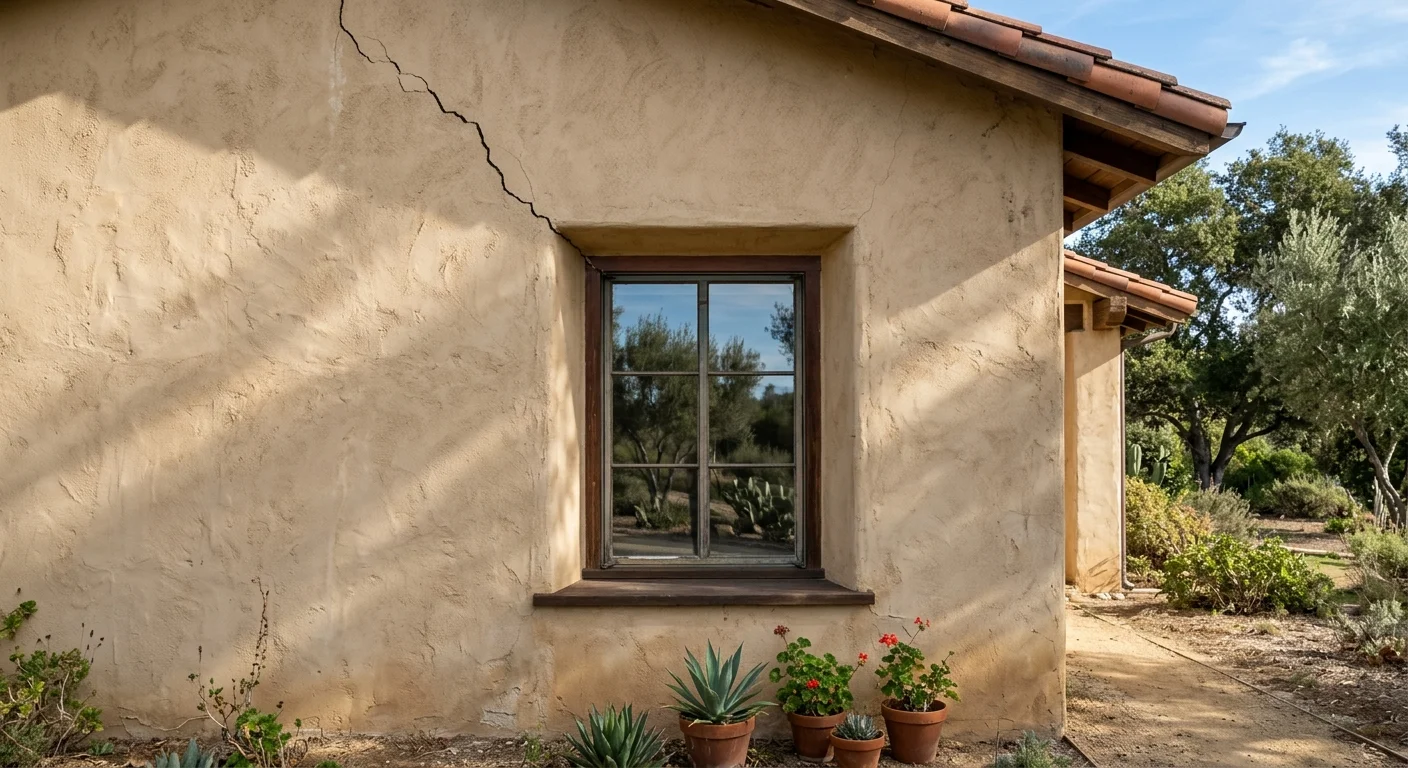
A photograph alone can’t confirm what’s happening behind the finish. Check the nearby openings, wall transitions, patches, and interior surfaces before requesting a repair scope.
Why the crack’s path matters more than its width alone
Width is only one detail. The crack’s starting point, direction, length, and surrounding surfaces provide more context. A narrow diagonal line and a wider diagonal opening shouldn’t automatically receive the same repair plan.
Start by finding both ends. Note whether the line begins at a window corner, door corner, wall opening, or repaired area. Follow it until it stops, disappears beneath trim, or enters another finish. Don’t assume the most visible section is the complete crack.
Photograph the entire wall first. Then take closer images showing the crack’s path. Include a recognizable nearby feature, such as the window or door, in each frame. This helps a stucco contractor understand where each close-up belongs.
Record the date without guessing when the crack began. If older photographs show the same wall, compare them. A contractor can review that history without relying on an uncertain description.
Don’t label the crack structural from appearance alone. A diagonal path is a reason to inspect more carefully, not proof of one cause. Our guide to stucco crack types in San Diego explains how contractors describe visible patterns without treating them as a complete diagnosis.
The same caution applies to hairline language. A thin line can cross several materials or continue beyond the area you can see. Review hairline versus structural stucco cracks before using either label in a quote request.
For a Descanso property, identify the exact wall and opening. “Diagonal crack on the house” isn’t enough. “Crack leaving the upper-left window corner on the south wall” gives the contractor a clearer starting point.
What to inspect around openings and wall transitions
Stand back and examine the entire opening before touching the crack. Look around all four corners of the window or door. Note any second crack, separated joint, patched edge, stain, bulge, or loose-looking finish.
Next, inspect where the stucco meets another surface. That might include trim, masonry, siding, a wall return, or an addition. Describe what you can see without assigning a cause. A visible gap is a useful observation. Calling it a failed waterproofing system without an assessment isn’t.
Check the matching interior area when it’s safely accessible. Record visible staining, damaged paint, or a line in the interior finish. Don’t conclude that an exterior crack caused an interior mark. Simply tell the contractor that both conditions exist.
Avoid pushing tools into the crack. Don’t remove trim or open the wall just to investigate. Those actions can change the condition before a professional sees it. Clear photographs and written notes preserve the original pattern.
Also note anything attached near the crack. A light, cable, vent, fastener, or decorative feature can affect access and the written scope. The contractor should see those items before choosing a repair boundary.
Window and door areas deserve careful evaluation because several visible surfaces meet there. Our article about stucco around windows, leaks, and repair offers a broader inspection checklist.
Conditions can differ from wall to wall on the same Descanso home. Don’t assume a repair used elsewhere will fit this opening. Ask the contractor to inspect the actual crack, nearby transitions, and accessible adjoining surfaces.
If the contractor recommends work beyond the finish, ask what visible condition led to that recommendation. The answer should appear in the written scope. That creates a clear connection between the observed problem and the proposed work.
How previous patches can hide the original crack pattern
An older patch can interrupt the line you see today. It may also make the wall’s original crack path difficult to follow. Treat the patch as part of the inspection area, not proof that the earlier problem was solved.
Look for changes in texture, color, surface level, or patch shape. Photograph the whole patched section. Include every place where a new line enters or exits it. Don’t scrape the surface to prove where old work ends.
If you know when the patch was completed, share the date and any paperwork. If you don’t know, say so. A confirmed gap is more useful than an invented history.
Previous invoices may identify the wall and stated repair area. They may also describe materials or finish work. Give those records to the contractor, but don’t assume every listed step can be confirmed from the current surface.
Ask whether the new scope addresses only the visible crack or includes the older patch. That distinction affects the repair boundary and texture-matching discussion. It should be settled before work begins.
A small surface repair may be described as stucco patching. The contractor still needs to define what gets removed, what remains, and how the repaired area meets the surrounding finish. Our guide to why a stucco patch cracks again can help you prepare questions about an older repair.
Don’t ask a contractor to hide the line without first reviewing its route. Paint or a thin surface treatment can make an area look different, but appearance alone doesn’t establish what was repaired underneath.
For quote comparisons, show every contractor the same photographs and history. Point out the previous patch before each inspection. Otherwise, one proposal may address the visible line while another includes a larger patched section. Those aren’t equivalent scopes.
When the wall needs assessment beyond surface repair
Surface repair may not be the only question. Ask for a broader assessment when the crack crosses an older patch, continues through a transition, appears around more than one opening, or accompanies another visible wall condition.
That doesn’t mean the wall has a confirmed structural problem. It means the repair decision needs more information than a crack photograph provides. A licensed stucco contractor can assess the stucco work. The contractor may also recommend evaluation by another qualified professional when the condition falls outside that trade.
Tell the contractor about changes you’ve observed. Use dates, photographs, and locations. Avoid conclusions such as “the wall is moving” unless a qualified professional has confirmed that statement.
Ask whether any concealed area needs to be opened before the final scope can be set. If so, the proposal should explain the planned opening and what decisions depend on that inspection. Don’t assume the same scope applies before and after concealed conditions are viewed.
Permit requirements can’t be determined from the crack’s appearance. They depend on the proposed work and the authority responsible for the property. Ask the contractor which building department has jurisdiction over your Descanso address and whether the planned scope requires approval.
California regulates certain exterior wall assemblies in mapped wildland-urban interface areas through Building Code Chapter 7A. A page or contractor shouldn’t declare that a specific parcel is inside or outside such an area from the city name alone. Confirm the parcel through Cal Fire mapping and the local building department.
For stucco work, California’s contractor classification is C-35, lathing and plastering. Verify any contractor’s status through the official CSLB license check. Match the business name and license details to the proposal you received.
What a written crack repair scope should include
A written scope should identify the exact wall and repair area. It should describe the diagonal crack, its relation to the opening, and any older patch included in the work. “Repair stucco” leaves too much unresolved.
Ask the contractor to state what gets removed and what stays. The scope should explain how the work area will be selected and what happens if the exposed conditions differ after opening. It should also separate confirmed work from optional work.
The document should identify the planned finish and texture approach. An exact visual match shouldn’t be assumed from a short description. Ask how the contractor will review texture, color, and the transition into the existing wall.
Protection and cleanup also belong in the scope. The proposal should identify nearby surfaces or attached items that affect access. If a window, door, fixture, or planted area sits beside the crack, discuss it before signing.
Ask who handles any required permit or inspection. Don’t accept a guess based only on the repair’s visible size. Confirm jurisdiction and requirements with the contractor and the building department responsible for the address.
The contract should name the contractor doing the work. Check that party through CSLB rather than a third-party directory. Stucco Pro SD is a referral service. We connect homeowners with licensed independent local pros and don’t perform physical repairs.
California limits a home improvement downpayment to $1,000 or 10 percent of the contract amount, whichever is less. Keep that “whichever is less” condition attached to the rule. Don’t treat 10 percent as an automatic amount for every contract.
When comparing proposals, align their boundaries first. One contractor may propose isolated stucco crack repair, while another includes an older patch or a larger finish area. Compare what each scope covers, not just the final line on the proposal.
A strong scope gives you clear decision points. It states the observed condition, planned work, finish approach, responsible contractor, and process for unexpected findings. That clarity matters when a diagonal crack crosses several visible areas.
When to call us
Call when a diagonal crack reaches an opening, crosses an older patch, or needs a written professional repair scope. A licensed stucco pro should inspect the actual Descanso wall before the repair method is chosen.
Call us at (858) 400-4352 and we’ll connect you with a licensed local stucco contractor.