A verified current San Diego price range for stucco removal couldn’t be confirmed from an approved source. The reliable answer comes from an itemized contractor quote based on your walls, access, disposal needs, and what may be uncovered beneath the finish.
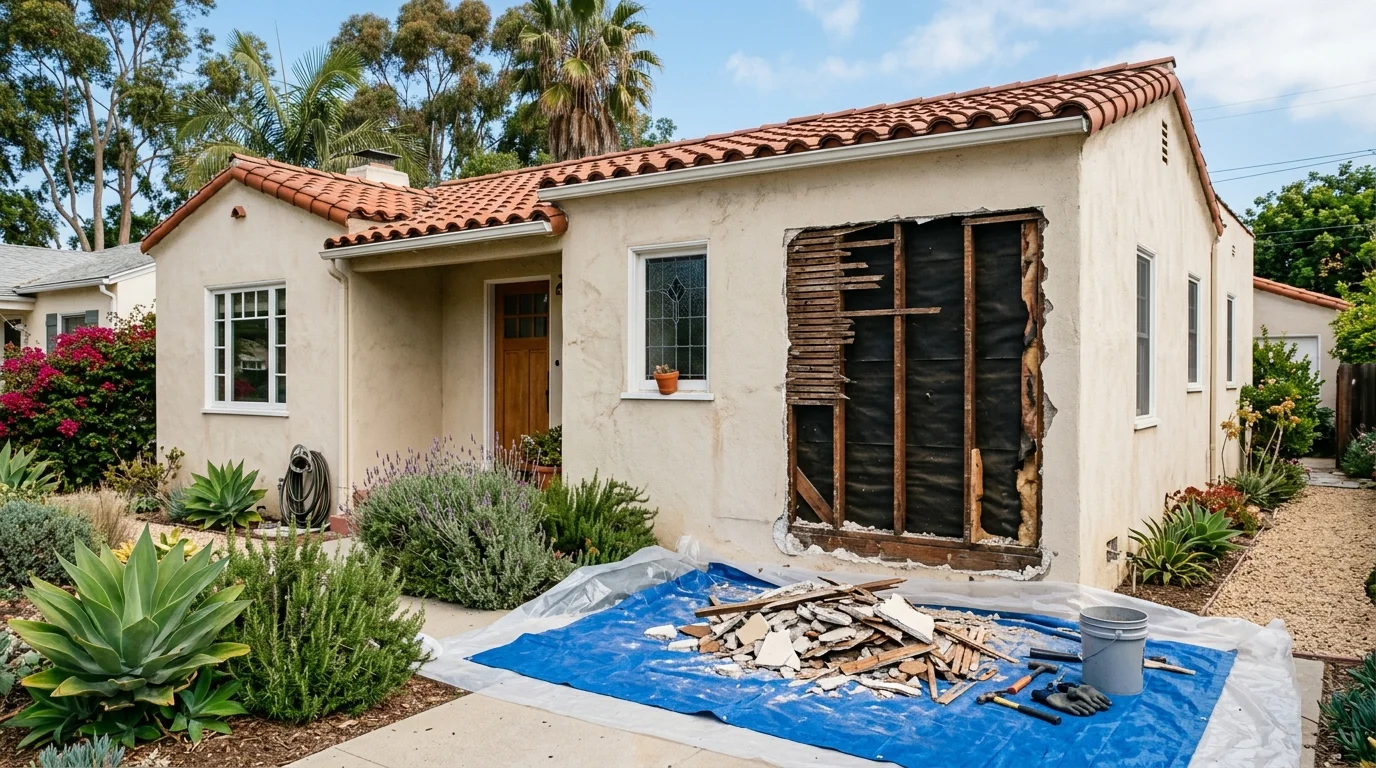
That means the lowest total isn’t automatically the lowest final cost. Before comparing bids, make sure each contractor is pricing the same removal boundary and follow-up work.
Why removal quotes vary more than patch quotes
A patch quote deals with a defined damaged area. Removal opens a larger section and adds several connected tasks. The contractor must identify the stopping points, protect nearby surfaces, remove the material, manage debris, and leave the exposed wall in the agreed condition.
The term “stucco removal” can also describe different jobs. One quote may cover a small section around a window. Another may cover an entire wall. A third may include removal before siding, waterproofing work, or a new stucco system. Those scopes shouldn’t be compared as though they’re interchangeable.
Start by asking what “removed” means in each proposal. Does it include only the visible finish? Does it include underlying stucco layers? Is the lath part of the quoted removal? Where will the contractor stop around corners, openings, trim, and roof connections?
If you’re still deciding whether removal is appropriate, read when stucco has to come off. That article addresses the repair decision. This page focuses on the quote after removal becomes a serious option.
A detailed stucco removal scope should name the included surfaces and exclusions. It should also describe what happens if the exposed wall differs from the expected condition.
Without those details, two totals may represent different jobs. One might include protection and hauling. The other might leave those items for later. Comparing only the bottom line hides that difference.
How wall area, access and finish layers affect labor
Contractors need more than the home’s overall square footage. They need the actual wall area included in the removal scope. Doors, windows, attached features, corners, and separate elevations affect how that area is measured and approached.
Our guide to how stucco jobs are measured and bid explains why wall measurements matter. For removal, those measurements should connect to a marked or written boundary. “Front wall only” may sound clear, but transitions near returns and side walls can still create uncertainty.
Access deserves its own line of discussion. A ground-level wall beside an open driveway presents a different setup from an upper wall above landscaping. A City Heights property with a narrow side passage may need a different debris path than an open site elsewhere in the county. A Chula Vista yard with a patio cover or an El Cajon wall behind planted areas can also change the working space.
Ask the contractor to note these conditions before quoting:
- Which walls and elevations are included
- Whether upper-wall access is included
- How attached fixtures and nearby surfaces are handled
- Where removed material will travel through the property
- Whether the quote assumes clear access on workdays
Finish layers also affect the scope. Paint, finish coats, repairs, trim, and transitions can make the visible surface more involved than a plain field wall. The quote should state whether the contractor expects to remove every layer to the same stopping point.
Don’t rely on a single per-square-foot figure without those assumptions. Area is one input. Access, boundaries, layers, and protection determine what that measurement means in practice.
What disposal and site protection add to the scope
Removal produces heavy, irregular debris. A complete quote should explain who handles containment, loading, hauling, and disposal. No verified local disposal rate was available for this page, so confirm the current charge with the contractor and the disposal facility involved.
Ask whether disposal appears inside the quoted total or as a separate allowance. If it’s an allowance, the proposal should explain how the final amount will be documented. You should also know whether the quote covers all removed layers or only a stated volume.
Site protection isn’t a decorative extra. It defines how the contractor plans to manage the work area. The scope may need to address windows, doors, paving, planting areas, air-conditioning equipment, and routes used to carry debris. The exact protection plan depends on the property.
San Diego sites can present very different hauling paths. A property near Interstate 5 may still have limited access behind the home. A house near State Route 94 may have a long slope or steps between the wall and loading area. The route matters more than the neighborhood name.
Before accepting an exterior stucco removal quote, ask these questions:
- What surfaces will be covered or isolated?
- Who moves outdoor furniture and removable items?
- Where will debris be staged before hauling?
- Is final cleanup included?
- Are disposal charges fixed, documented, or treated as an allowance?
- What conditions could change the disposal scope?
The proposal should also identify exclusions. Interior dust control, detached structures, concealed debris, or restricted access shouldn’t remain unspoken. Clear exclusions let you prepare the property and compare bids fairly.
For permit questions, don’t rely on assumptions. Requirements can depend on the address and the larger project. For property within city limits, confirm the current process with City of San Diego Development Services. For another jurisdiction, contact that property’s local building authority.
What happens when removal exposes damaged lath or sheathing
A removal quote is partly a plan for known work and partly a plan for discovery. Stucco hides the wall components beneath it. The visible surface alone can’t establish every concealed condition before opening the assembly.
The proposal should explain how unexpected findings are handled. Don’t settle for a broad sentence authorizing any needed repair. Ask for a pause, documentation, and written pricing before additional work begins.
Useful documentation can include photos, the location of the exposed condition, and a description of the proposed response. The contractor should distinguish between work already included and work requiring a change to the contract.
If damaged lath appears, the contractor may recommend a separate repair scope. If the project proceeds toward new stucco, re-stucco service may follow removal and wall preparation. Those later stages should be separated clearly enough that you can see what you’re buying.
Sheathing or other concealed damage can also involve work outside the original stucco scope. The stucco contractor should identify the condition and explain what must happen before the exterior finish continues. If another trade is needed, the proposal should say who coordinates that work and who contracts for it.
Ask how the contractor will handle these decision points:
- What condition is assumed beneath the existing stucco?
- Which exposed-wall tasks are included?
- What triggers a written change order?
- Who approves added work?
- Will photos be provided before the wall is covered again?
- How will schedule changes be communicated?
Don’t ask a bidder to invent a concealed-damage total. Ask for a clear process instead. That gives you control without pretending the unopened wall is fully known.
The final scope should also define the stopping condition. “Remove stucco” doesn’t say whether the wall will be left exposed, temporarily protected, prepared for another system, or included in a later re-stucco phase. That boundary belongs in writing.
How to compare an itemized removal quote
Put competing quotes beside each other and compare scope lines before totals. Each proposal should identify the same walls, stopping points, protection, hauling, disposal, and exposed-wall assumptions. If one bidder priced a different boundary, ask for a revised version before choosing.
A practical comparison starts with these categories:
- Removal area and marked boundaries
- Included finish and base layers
- Treatment of lath and exposed wall components
- Access equipment and setup
- Protection for nearby property
- Debris staging, hauling, and disposal
- Cleanup and the condition left behind
- Allowances, exclusions, and change-order steps
- Follow-up work after removal
Watch for vague terms such as “as needed” when no approval process follows them. The issue isn’t the phrase itself. The problem is uncertainty about who decides, how the work is priced, and when you approve it.
Confirm the contractor’s license through the official CSLB license check. Match the business name and license details to the proposal you received. Stucco Pro SD refers homeowners to licensed, independent local pros and doesn’t perform the physical work.
Payment terms deserve the same close reading. California’s home improvement downpayment cap is $1,000 or 10 percent of the contract amount, whichever is less. Confirm that the written agreement follows the current requirement before paying.
Finally, compare how each contractor handles uncertainty. A strong quote doesn’t pretend concealed conditions are known. It states the assumptions, documents discoveries, and requires approval before added work begins.
If a bidder can’t explain an unclear line item, don’t guess what it includes. Ask for the wording to be revised. A useful quote should let you understand the removal cost, the possible additions, and the exact point where another scope begins.
When to call us
Call when removal covers more than a limited surface patch, affects concealed wall components, or leads into a new stucco system. Call us at (858) 400-4352 and we’ll connect you with a licensed local stucco contractor.